
Does HRT Help Rosacea? Why It Can Go Either Way After 45
Quick summary
HRT may help rosacea in some women over 45, mainly by reducing the hot flushes that set it off, and research suggests lower estrogen goes with more severe redness. It is not a rosacea treatment, it is prescribed for menopause symptoms, and for some women redness gets worse in the first weeks after starting or changing a dose. The honest answer is that it can go either way, and only your GP can weigh it for you. At Genova Skincare we see both stories every week, and skincare's job in the meantime is to keep the barrier calm. Results vary.
You started HRT for the night sweats and the 3am wake-ups. Three months on, your cheeks are either calmer than they have been in years or redder than ever, and nobody warned you either was possible. At Genova Skincare we hear both from women over 45. This post explains what estrogen does to rosacea-prone skin, when HRT may help, when it can make redness worse, and what skincare can do in the meantime.
Why Women Over 45 Ask Whether HRT Helps Rosacea
Rosacea is more common in women and typically peaks between 30 and 50, according to a review in Australian Family Physician (Maor and Chong, 2017). That window overlaps perimenopause, so many women meet rosacea and hormone change in the same few years and wonder whether one drives the other.
A review in Clinical and Experimental Dermatology (Kamp and colleagues, 2022) puts it plainly: menopausal flushing is known to exacerbate or even precipitate rosacea. The same review notes there is very little research on menopause and rosacea, which is why the internet is confident in both directions with little data behind either.
What Estrogen Does to Rosacea-Prone Skin After 45
Estrogen helps the skin hold water and keeps the small facial vessels stable. As it falls, the barrier thins and vessels dilate more readily. The Clinical and Experimental Dermatology review describes flushing in around three quarters of perimenopausal and menopausal women, driven by dilated skin vessels, possibly from a loss of vascular control linked to estrogen deficiency.
A small 2024 study in Skin Research and Technology (Yang, Wang and Jiang) looked at 59 women aged 45 to 55 with the redness-and-vessels type of rosacea. Lower estradiol went with more severe redness. It was one clinic's patients at one point in time, so it shows a link, not a cause, and it did not test HRT. Still, it fits what many women notice: the redder years arrive as estrogen leaves.

When HRT May Help Rosacea in Menopause
The clearest route is indirect. Flushing generally responds to estrogen therapy, the Clinical and Experimental Dermatology review notes, and a flush is one of the strongest rosacea triggers there is. Fewer flushes means fewer rushes of blood to the cheeks, and for some women that alone leaves the skin calmer between flares.
The second route is the barrier. Skin that has become dry, thin and reactive may hold water better on HRT, so it stings and flushes less at ordinary things: wind, a warm room, a glass of wine. Our post on HRT and menopausal skin after 45 covers those general changes.
Worth saying clearly: HRT is prescribed for menopause symptoms, not for rosacea. If it helps your skin, that is a welcome side benefit of a decision made for other reasons.
When HRT Can Make Rosacea Worse After 45
The other story is also real. Some women notice more redness, warmth or a crop of bumps in the first weeks after starting or changing a dose. Three likely reasons.
First, the body adjusts. Hormone levels swing while a new dose settles, and swings are what reactive vessels dislike. Many early side effects of HRT ease over the first three months.
Second, the progestogen. Combined HRT pairs estrogen with a progestogen, and some progestogens are linked to oilier skin and breakouts, which can look like or aggravate the bumpy type of rosacea. Our post on breaking out on HRT after 45 explains that. Third, coincidence: rosacea often first appears in this age band with or without HRT.
If redness is clearly worse three months in, that is a review with your prescriber, not a reason to stop on your own. Formulation, dose and route can all be adjusted.
HRT and Rosacea After 45: Comparison Table
| Part of the picture | What HRT may change | What HRT will not change | Who decides |
|---|---|---|---|
| Hot flushes | Often fewer and milder | Non-hormonal triggers (heat, alcohol, spice) | GP or menopause doctor |
| Background redness | May settle if flushing drives it | Redness from sun damage or fixed vessels | GP, sometimes dermatologist |
| Bumps and pimples | Can worsen at first on some progestogens | Need their own rosacea medicine if persistent | GP |
| Broken capillaries | Nothing directly | Only laser or IPL closes them | Laser clinician |
| Barrier and sensitivity | May improve hydration over months | Damage from harsh products or hot water | You, with gentle skincare |
For persistent bumps, see rosacea cream over the counter in Australia. For visible vessels, see broken capillaries after 50: serum or laser.
Skincare for Rosacea-Prone Skin on HRT: Where a Redness Serum Fits
Whichever way HRT goes, the skin needs the same thing in the meantime: a barrier that is not being stripped, and fewer daily triggers. That means lukewarm water, a mild cleanser, a moisturiser, mineral SPF, and something designed for the look of redness in between.
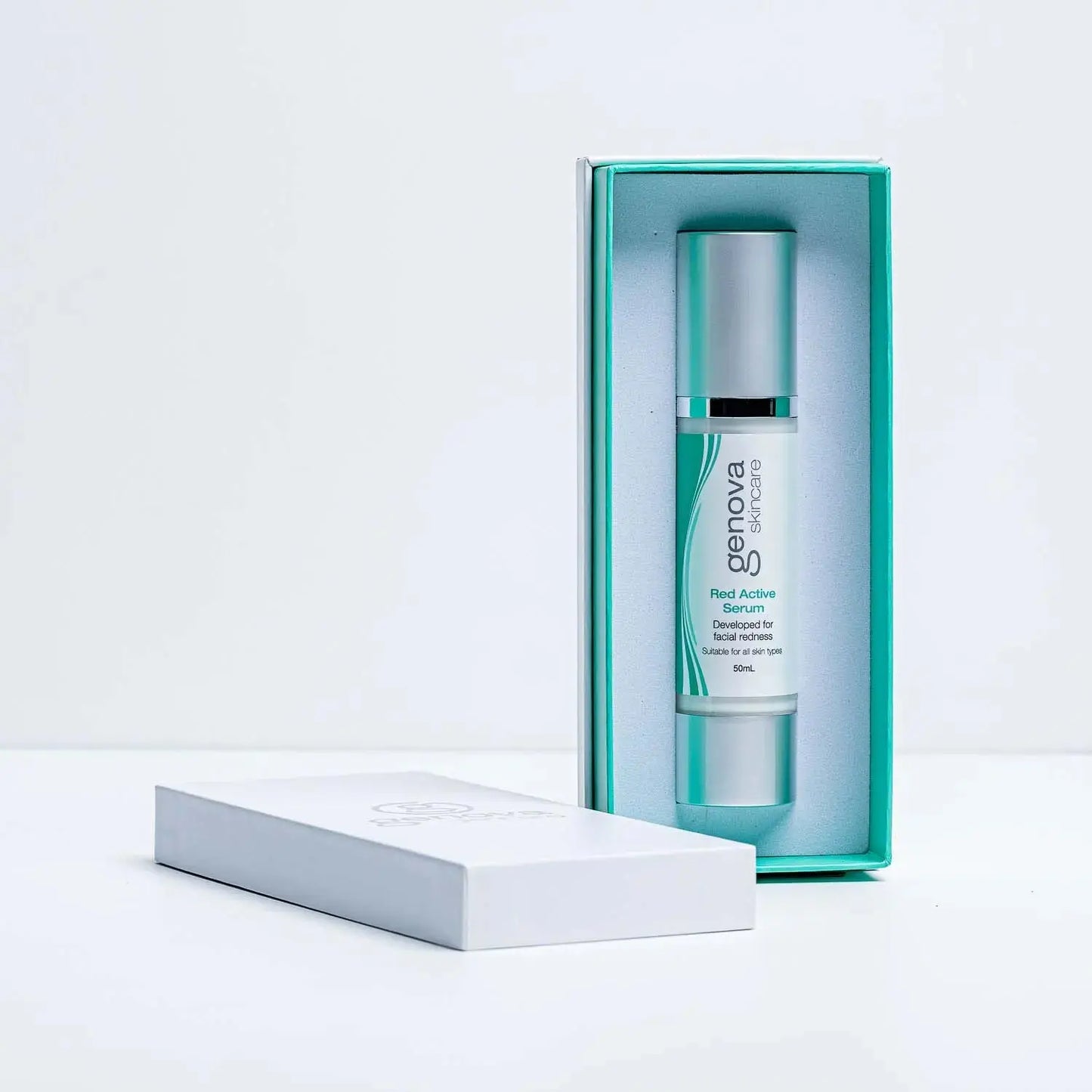
The Genova Red Active Serum is one option for that middle step. It is an Australian made cosmetic serum built around two peptides, Telangyn (developed for the look of facial redness) and Delisens (for the feeling of easily irritated skin), with allantoin and rice bran oil. Their data comes from the ingredient maker, not independent trials, so we say designed to support calmer-looking skin and nothing stronger. It does not act on hormones and is not a substitute for HRT or any rosacea medicine.

A peptide serum designed to support the look of calmer, less reactive skin over 6 to 12 weeks. Free standard delivery on Australian orders over $50 and a 30-day money-back trial.
Realistic expectations: a cosmetic serum works on the look and feel of the skin, gradually. Most people who notice a change do so after 6 to 8 weeks, with a fairer judgement at 12. It will not stop a flush, treat rosacea, or change how your HRT behaves. Results vary, and skin on a new dose can shift for reasons unrelated to the serum.
Pros and Cons of a Redness Serum Alongside HRT After 45
Pros
- It gives the skin something calming while HRT settles, without an active that might sting.
- It layers under moisturiser and SPF, so the routine does not change.
- No known interactions between its ingredients and hormone therapy.
- The 30-day trial means a fair test costs nothing if it does not suit you.
Cons
- Gradual: 6 to 12 weeks is the honest window, and results vary.
- Cannot treat rosacea, stop a flush, or close a broken capillary.
- Peptide data comes from the ingredient maker, not independent trials.
- If a progestogen or a dose is driving the redness, your prescriber fixes that, not skincare.
How to Use a Redness Serum With Rosacea-Prone Skin After 45
- Patch test on the inner forearm for two or three days first, especially if your skin is flaring.
- Cleanse with lukewarm water and a mild cleanser. Pat dry, leaving the skin slightly damp.
- Apply a small amount to the face and neck, morning and night, with light outward strokes.
- Follow with a barrier-supporting moisturiser, then mineral SPF in the morning.
- Introduce it on its own. If you are also starting a GP-prescribed cream, add one product at a time, a week or two apart.
- Keep a short diary of flushes and redness for 12 weeks, so you and your GP can see what is doing what.

A lightly foaming wash with allantoin and cucumber extract, designed to cleanse without stripping a thinning barrier. Use with lukewarm water.
Who This Approach Is For, and Who Should See a GP First, After 45
A gentle routine with a redness serum suits you if:
- You are on HRT, or considering it, and your skin has become redder, drier or more reactive.
- Your redness comes and goes with heat, wine or a warm room rather than sitting there all day.
- You will give it 12 weeks and keep the rest of the routine simple.
See your GP first if:
- Redness arrived or worsened within weeks of starting or changing HRT. That may be a formulation or dose issue for your prescriber.
- You have bumps, pustules, thickening on the nose, or irritated eyes. Those subtypes need medicine, not skincare.
- You are thinking of starting or stopping HRT because of your skin. Skin alone is rarely the right basis for that decision.
Myths About HRT and Rosacea in Menopause
Myth: HRT cures rosacea. Reality: rosacea is a long-term condition with no cure. HRT may reduce the flushing that triggers it, but it is prescribed for menopause symptoms and does not treat rosacea itself.
Myth: if your face gets redder on HRT, you should stop. Reality: early redness often settles within three months, and the progestogen type or route can be changed. Stopping without a review throws away the benefits you started it for.
Myth: a "hormone-balancing" cream can do what HRT does. Reality: no cosmetic acts on hormones. A redness serum works on the look and comfort of the surface. Our post on whether skincare can replace estrogen loss draws that line.
Myth: rosacea disappears after menopause. Reality: flushing often eases once hormones settle, but rosacea rarely goes away on its own. Our guide to rosacea in menopause covers what to expect.
FAQ: HRT and Rosacea After 45
Does HRT help rosacea?
It may, indirectly, by reducing the hot flushes that trigger flares. It is not a rosacea treatment and does not help everyone. Ask your GP.
Can HRT make rosacea worse?
Yes, for some women, usually in the first weeks after starting or changing a dose. The progestogen and hormone swings are the usual suspects. Most early effects settle within three months; if not, ask for a review.
Does low estrogen cause rosacea?
Not on its own, but a 2024 study of 59 women aged 45 to 55 found lower estradiol went with more severe redness-type rosacea, and falling estrogen drives the flushing that sets it off.
Will estrogen cream help rosacea?
There is no good evidence that a topical estrogen cream helps rosacea, and in Australia estriol or estradiol creams need a doctor. Our post on estriol face cream in Australia explains what can and cannot be bought.
Is the Genova Red Active Serum safe to use with HRT?
There are no known interactions between its ingredients and hormone therapy. Your skin's response can change as HRT settles, so patch test and introduce it on its own.
Calmer-Looking Skin After 45 While Your HRT Settles
An Australian made peptide serum for facial redness and sensitive skin. Try it for 30 days with a money-back trial.
 Genova Red Active Serum
Peptide serum designed to support the look of calmer, more even skin over 6 to 12 weeks.
Free standard delivery on Australian orders over $50. 30-day money-back trial.
A Calm Word About HRT and Rosacea After 45
If your skin has calmed on HRT, enjoy it. If it has flared, that is information for your next appointment, not a verdict on your decision. Either way the daily job is the same and it is gentle: lukewarm water, a kind cleanser, sunscreen, and patience. Your skin has been through a lot of change. It is allowed a few months to catch up.
This article is general information, not medical advice. Decisions about starting, changing or stopping HRT belong with your doctor. Genova Skincare products are cosmetics, not therapeutic goods; they do not act on hormones and are not designed to diagnose, treat or manage rosacea or any medical condition. Individual results vary. For persistent redness, bumps, eye irritation or new symptoms on HRT, please see your GP.
References
- Kamp E, Ashraf M, Musbahi E, DeGiovanni C. Menopause, skin and common dermatoses. Part 2: skin disorders. Clinical and Experimental Dermatology. 2022;47(12):2117-2122.
- Yang F, Wang L, Jiang X. Clinical characteristics of rosacea in perimenopausal women. Skin Research and Technology. 2024;30(1):e13542.
- Maor D, Chong AH. Rosacea. Australian Family Physician. 2017;46(5).
This article is part of our complete guide to menopause facial redness.