
Broken Capillaries on the Face After 50: Will a Serum Help or Do You Need Laser?
Quick summary
A serum cannot remove broken capillaries on the face after 50. Those fine red or purple lines are dilated vessels that stay open, and only a vascular laser, IPL or a similar clinic procedure can close them. What a serum can do is support the look of the diffuse redness around them, which is often what makes the vessels stand out. At Genova Skincare we are clear about that split: the Red Active Serum is for the background pinkness of sensitive skin over 50, and a clinic is for the vessels themselves. Results from either vary.
One thin red line beside your nose a few years ago has become a small web across one cheek, and foundation only half hides it. If you are over 50, hot flushes, sun and a thinner barrier have all played a part, and the question is practical: do I buy a serum, or book a laser? It depends which part of the redness you want to change. This post explains the difference, what each option can and cannot do, and how to stop it spreading.

A peptide serum designed to support the look of calmer, more even skin over 6 to 12 weeks. Made in Australia. Free standard delivery on Australian orders over $50 and a 30-day money-back trial.
What Broken Capillaries on the Face After 50 Actually Are
The medical name is telangiectasia. The capillaries are not broken in the sense of leaking; they are tiny vessels near the surface that have widened and lost the ability to narrow again. They show through as fine red, pink or purple threads on the cheeks, the sides of the nose and the chin.
That is why no cream can make them disappear. A topical works on the surface layers. A widened vessel is a structural change that needs energy delivered into the vessel wall to close it, which is what a vascular laser or IPL does.
Why Broken Capillaries Show Up More After 50 and in Menopause
DermNet lists sun-damaged and ageing skin as the most common setting for facial telangiectasia, alongside rosacea, smoking, pregnancy, some blood-pressure medicines and long-term steroid creams. Five decades of Australian sun is the biggest single contributor for most women.
Menopause adds two things. Falling estrogen thins the skin, so vessels that were always there become easier to see. And hot flushes push blood into the face many times a day for years. Research in Australian Family Physician (Maor and Chong, 2017) notes that rosacea, the condition most linked to visible facial vessels, is more common in women and peaks between 30 and 50, overlapping perimenopause. Repeated flushing over years is widely thought to make surface vessels more visible; our post on menopause flushing versus rosacea explains how to tell which you have.

Can a Serum Remove Broken Capillaries After 50? The Honest Answer
No. DermNet's treatment options for telangiectasia are vascular laser, intense pulsed light, electrosurgery and sclerotherapy. Creams are not on the list, and any product that claims to remove or repair broken capillaries is overpromising.
What a serum may do is change how much the vessels stand out. Most women over 50 with visible capillaries also have diffuse pinkness across the same area from a reactive, thinning barrier. When that background calms, the threads read as less obvious. That is a modest, real cosmetic benefit, and the honest scope of a product like ours.
Serum vs Laser vs IPL for Broken Capillaries After 50: Comparison Table
| Option | What it does | What it cannot do | Downtime and risks | Time to judge |
|---|---|---|---|---|
| Cosmetic redness serum | Supports the look of calmer, more even background skin | Close or remove a vessel | None; patch test first | 6 to 12 weeks |
| Vascular laser (pulsed dye, Nd:YAG) | Targets haemoglobin in the vessel and closes it | Stop new vessels forming or reduce flushing | Bruising, swelling; rare blistering, pigment change, scarring | Often more than one session |
| IPL | Broad light that treats vessels and diffuse redness together | Prevent recurrence; needs repeat visits | Redness for days; pigment risk on darker or tanned skin | Usually several sessions |
| Electrosurgery, sclerotherapy | Closes single larger vessels | Treat a diffuse web or background pinkness | Small scabs; small scar risk | One or two sessions |
| Daily SPF and trigger care | Slows new vessels and flushing damage | Reverse existing vessels | None | Ongoing |
Two cautions from the Australian Family Physician review: recurrence after laser or IPL is common and re-treatment is normal, and adverse effects can include blistering, pigment loss and scarring, so the operator matters. The Australian Prescriber review (Rivero and Whitfeld, 2018) adds that laser will not reduce how often you flush. Costs vary widely, so ask for a written quote for the full course.
Where the Red Active Serum Fits for Menopausal Skin With Broken Capillaries
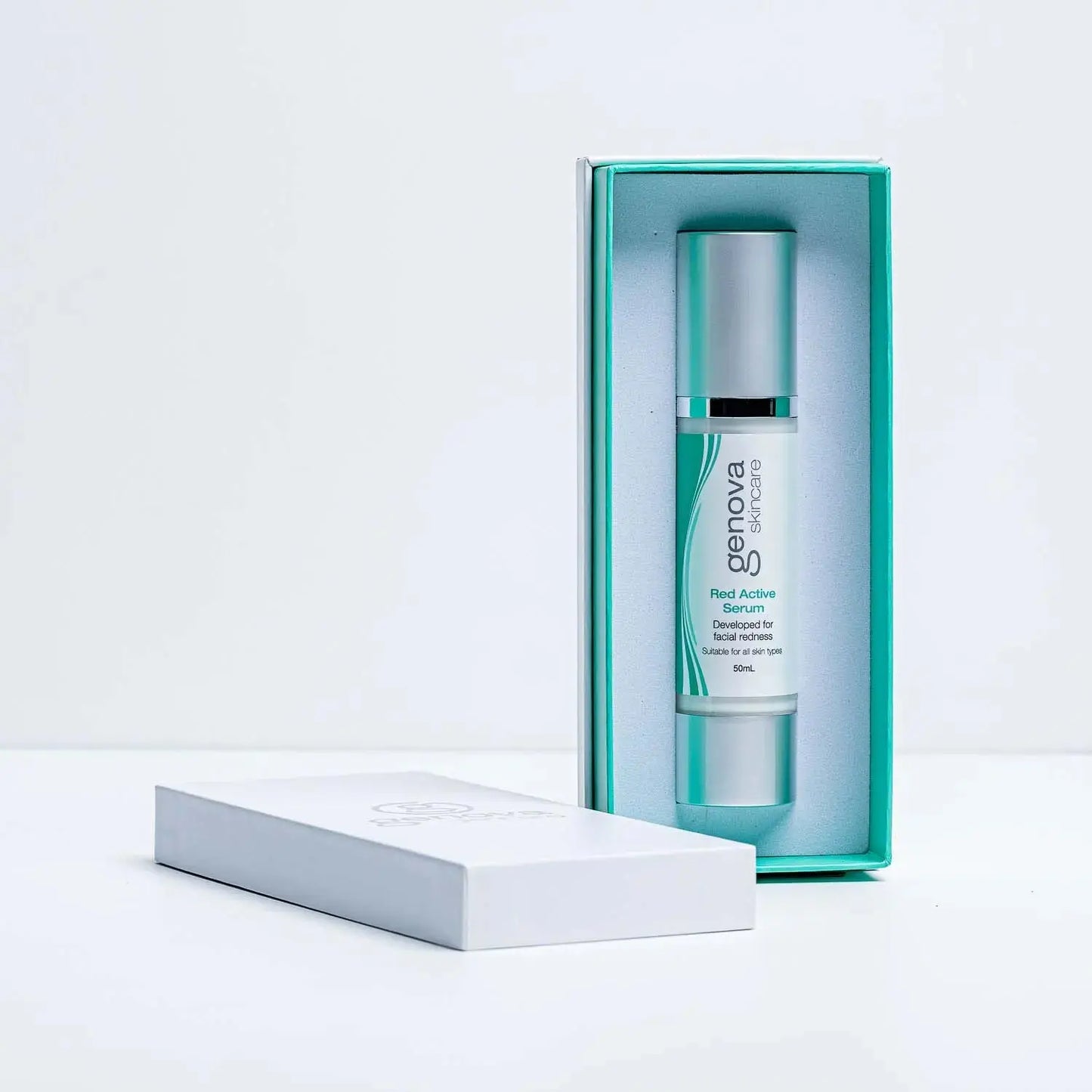
It is the step you use every day, whether or not you book a laser. The Genova Red Active Serum is built around two peptides, Telangyn and Delisens, with allantoin and rice bran oil in a light base. Telangyn is a tetrapeptide developed for the look of facial redness; Delisens is a hexapeptide developed for the feeling of easily irritated skin. Their data comes from the ingredient maker, not independent trials, so we say designed to support calmer-looking skin and nothing stronger. Our post on whether peptides help menopausal facial redness has the detail.
It is made in Australia, suits all skin types, and sits under moisturiser and SPF. If you have a laser or IPL course, ask the clinic when to pause and restart it.

A lightly foaming wash with allantoin and cucumber extract, designed to cleanse without stripping a thinning barrier.
Realistic Expectations After 50: What Changes and What Does Not
Realistic expectations: with a serum, the vessels stay where they are. What may change over 6 to 12 weeks of twice-daily use is the background pinkness and the feeling of reactivity, so the threads look less obvious. With laser or IPL, vessels can close after one or several sessions, and new ones can appear later, especially without daily SPF. Results vary with both, and neither stops a hot flush.
What a Redness Serum Cannot Do for Broken Capillaries
- It cannot close, shrink, repair or remove a widened vessel. That is a clinic procedure.
- It cannot stop a flush while it is happening, and does not act on hormones or any process inside the body.
- It cannot treat rosacea, a medical condition that needs a GP.
- It cannot undo sun damage or replace daily SPF, and it is not a substitute for, or equivalent to, any prescription cream or procedure.
Who Should Skip the Serum and Book a Laser Consultation Instead
- You have a few distinct vessels and little background redness. There is nothing for a serum to work on; a vascular laser is the direct answer.
- The vessels bother you enough that you have covered them daily for a year or more. Twelve weeks on a serum will not change the thing you mind.
- There are bumps, pustules or thickening on the nose alongside the vessels. See your GP first; this may be rosacea that needs medicine.
- A vessel has appeared suddenly, is raised, or bleeds. That needs a doctor, not a product.
If your face is broadly pink and reactive and the vessels are one part of that picture, start with the gentle routine and the serum, then decide about a clinic once the background has calmed.
How to Stop Broken Capillaries Getting Worse After 50
- Wear broad-spectrum SPF 50+ every morning, all year. Mineral formulas with zinc oxide are usually better tolerated. This is the single most useful step.
- Wash with lukewarm water and a mild cleanser. Hot water and scrubbing add to the flush.
- Keep a two-week trigger diary. Alcohol, hot drinks, spicy food, saunas and wind are common; our post on alcohol and menopausal skin explains why a glass of wine hits harder after 45.
- Apply a redness serum after cleansing, morning and night, then moisturiser and SPF. Patch test on the inner forearm first.
- Pause strong actives (retinoids, acids, scrubs) while the skin is flaring, and reintroduce one at a time.
- If you choose laser or IPL, pick an experienced operator, ask about pigment risk for your skin tone, and keep the SPF going afterwards.
FAQ: Broken Capillaries on the Face After 50
Can you reverse broken capillaries on your face?
Existing vessels can be closed with a vascular laser, IPL, electrosurgery or sclerotherapy. No cream, serum or supplement reverses them. Daily SPF and trigger care slow new ones.
Does menopause cause broken capillaries?
It is one contributor. Thinner skin makes vessels more visible, and years of hot flushes push blood to the face repeatedly. Sun remains the biggest factor for most Australian women.
How do you get rid of a red face in menopause?
Separate the flush from the fixed redness. A gentle routine, SPF and trigger care may calm the background over 6 to 12 weeks; fixed vessels need a clinic; frequent flushes are a GP conversation.
Is IPL or laser better for broken capillaries after 50?
A vascular laser is more targeted for distinct vessels. IPL suits diffuse redness with scattered vessels. Both often need repeat sessions and carry a pigment risk on darker or tanned skin.
Will a redness serum make broken capillaries less noticeable?
It may. A serum for sensitive, redness-prone skin can support a calmer, more even background, so the threads read as less obvious. The vessels themselves remain. Results vary.
For the Redness Around the Vessels After 50
An Australian made peptide serum for facial redness and sensitive skin. Try it for 30 days with a money-back trial.
 Genova Red Active Serum
Peptide serum designed to support the look of calmer, more even skin over 6 to 12 weeks.
Free standard delivery on Australian orders over $50. 30-day money-back trial.
A Calm Word About Broken Capillaries After 50
A few red threads on a cheek are a record of sun, heat and time, not a sign you did anything wrong. You can leave them, calm the skin around them, or have them closed at a clinic, and all three are reasonable. Whichever you pick, the SPF and the gentler routine will look after you.
This article is general information, not medical advice. Genova Skincare products are cosmetics, not therapeutic goods, and cannot remove broken capillaries or treat rosacea or any medical condition. Individual results vary. For visible vessels, sudden changes, or persistent redness, please see your GP, a dermatologist or a qualified laser clinician.
References
- DermNet. Telangiectasia. dermnetnz.org/topics/telangiectasia.
- Maor D, Chong AH. Rosacea. Australian Family Physician. 2017;46(5).
- Rivero AL, Whitfeld M. An update on the treatment of rosacea. Australian Prescriber. 2018;41(1):20-24.
This article is part of our complete guide to menopause facial redness.