
HRT and Menopausal Skin After 45: What It May Change
Quick Summary:
HRT (menopausal hormone therapy, MHT) is a prescription treatment for menopausal symptoms such as hot flushes, night sweats and disrupted sleep. It is not prescribed for skin, but estrogen supports collagen, ceramides and hydration, so some women notice skin improvements as a side benefit. The research is mixed: small studies suggest HRT may support skin thickness and hydration, while a large four-year trial found no difference in wrinkles. The decision belongs with your GP, and a peptide-led skincare routine works alongside either choice.

Your friend started HRT six months ago for the night sweats. Last week the first thing you noticed was her skin: less drawn, less dry, somehow more like her old face. You drove home wondering whether the patch on her arm was doing what your serums have not.
Will HRT fix my skin is a question many women carry into the GP waiting room. The answer is more interesting than a yes or a no, because HRT is a medical decision with a much bigger picture than your reflection.
Why Women After 45 Ask Whether HRT Will Help Menopausal Skin
The timing is impossible to miss. Skin changes arrive with the same hormonal shift that brings the flushes and the 3am waking. Research published in Maturitas by Lephart describes how falling estrogen reduces collagen production, slows cell turnover and weakens the skin's ability to hold water.
Women lose up to 30 per cent of their skin collagen in the first five years after menopause, then around 1 to 2 per cent each year after that. If estrogen loss caused the change, replacing estrogen should reverse it. The research says: partly, sometimes, and not for everything.
What the Research Says HRT May Change in Menopausal Skin
A 2025 narrative review in the Journal of Cosmetic Dermatology by Viscomi and colleagues gathered the available studies on HRT and skin quality. The pattern suggests HRT may support skin collagen content, thickness, elasticity and hydration in some women, with one randomised placebo-controlled trial reporting improved elasticity, thickness and hydration.
A 2022 study in Scientific Reports by Kendall and colleagues found that menopause changes the skin's ceramide profile, the lipids that hold the barrier together, and that these changes were prevented in women using HRT. Our post on the menopausal skin barrier covers why those lipids matter after 45.
What HRT May Not Change for Menopausal Skin After 45
The largest long-term test is the KEEPS skin ancillary study in Fertility and Sterility by Wolff and colleagues. Over four years, women using oral or transdermal estrogen showed no significant difference in facial wrinkle or rigidity scores compared to placebo. Genetics and ethnicity influenced wrinkling far more than hormones did.
The evidence splits along this line: HRT may help the qualities you feel (hydration, barrier comfort, plumpness), while established wrinkles and structural sagging appear far less responsive. Most studies are small, and researchers consistently call for larger trials.
Two more things matter. HRT in Australia is a prescription medicine for menopausal symptoms and bone protection; no Australian guideline recommends starting it for skin alone. Its benefits and risks differ with your age and health history, and that weighing-up belongs with your GP or a menopause specialist, not a skincare article.
HRT vs Skincare for Menopausal Skin: What Each Can and Cannot Do
Four broad paths sit in front of most women.
| Approach | What it may help | What it won't do |
|---|---|---|
| HRT (doctor-led) | Whole-body symptoms; hydration and barrier as a possible side benefit | Not prescribed for skin; wrinkle evidence is weak |
| Peptide-led skincare | Surface firmness, hydration, barrier support over 8-12 weeks | Cannot replace estrogen or refill structural volume |
| Lifestyle (sleep, movement, alcohol, SPF) | The conditions the skin lives in every day | Slow; cannot reverse established structural change |
| In-clinic treatments | Targeted structural change, faster results | Higher cost; needs a qualified practitioner |
These are not competitors. Most women land on a combination, and the skincare and lifestyle layers apply either way.
Where Skincare Fits Alongside an HRT Decision After 45
Whatever you and your doctor decide, your skin still needs daily surface support: even women on HRT are working with less collagen than they had at 40.
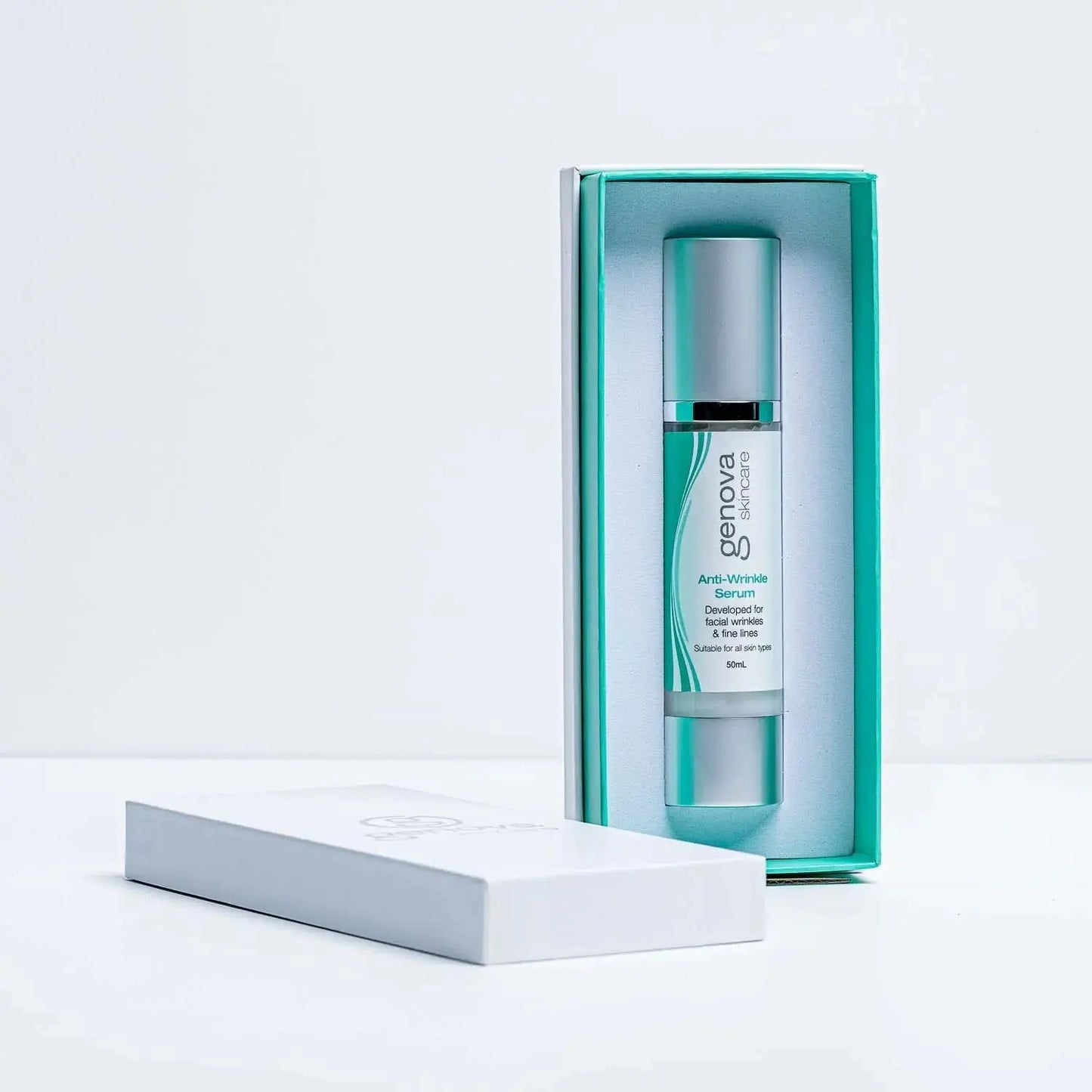
The Genova approach pairs three products. Genova Active Foaming Cleanser cleans without stripping the lipids the menopausal barrier struggles to rebuild. Genova Anti-Wrinkle Serum uses peptide signalling designed to support the collagen pathways estrogen used to drive. Genova Firming Cream, made in Australia under strict quality-control standards, supports the ceramide-rich barrier that menopause depletes. If your skin feels drier, thinner or less resilient after 45, start with the Ageing Skin Care Package as your daily surface-support routine: gentle cleanse, peptide serum, firming cream and barrier-focused care

Genova Active Foaming Cleanser
Daily SPF protects whatever progress the routine builds. Our guide to skincare ingredients that matter in menopause covers the wider ingredient picture. In Australia, this matters even more because UV exposure remains one of the largest external drivers of visible ageing, regardless of hormone status.
Realistic Expectations: A peptide-led routine may show change in hydration and skin feel within 4 to 6 weeks, and firmness over 8 to 12 weeks, whether or not HRT is part of your picture. Skincare cannot replace estrogen, and HRT is not a skin treatment. Results vary with genetics, sun history, sleep, stress and consistency.
Strengths of pairing skincare with a doctor-led HRT conversation
- Skincare supports the surface whichever way the decision goes
- Peptides and barrier lipids target the two systems estrogen loss hits hardest
- No waiting on hormones to do a job the evidence says they may not do for wrinkles
Limitations to keep in view
- Skincare cannot replicate the whole-body effects of estrogen
- HRT skin research is based mostly on small studies; results vary widely
- Deep wrinkles and structural sagging respond poorly to both creams and hormones
How to Approach the HRT and Skin Question: Step by Step
- List your symptoms. Flushes, sleep, mood, joint aches, skin changes. The full list matters more to your GP than skin alone.
- Book a long appointment with your GP or a menopause specialist. Ask about benefits and risks for your health history.
- Treat any skin benefit of HRT as a bonus, not the goal. No Australian guideline supports starting it for skin alone.
- Run a consistent topical routine either way. Gentle cleanse, peptide serum on damp skin, barrier cream, SPF 30+ every morning.
- Give it 8 to 12 weeks. Our guide to peptide results by month shows the typical order of change.
- Support the inside conditions too. Sleep, movement and alcohol all read on the same skin, whatever your hormone status.
Who This Guide May Suit (and Who Should See a Doctor First)
It may suit you if:
- You are 45 to 65 and wondering whether HRT explains a friend's improved skin
- You are on HRT and want skincare that supports the surface alongside it
- You have decided against HRT and want to know what skincare can realistically do
See your doctor first if:
- Hot flushes, night sweats or sleep disruption are significantly affecting your life
- You are considering starting, stopping or changing HRT
- You have a personal or family history that complicates hormone decisions
- A skin change is sudden, painful or doesn't fit the usual menopausal pattern
Frequently Asked Questions About HRT and Menopausal Skin
Will HRT get rid of my wrinkles?
The best long-term evidence says no. The four-year KEEPS trial found no significant difference in wrinkle scores between estrogen and placebo. Hydration and skin feel may improve; established wrinkles appear largely unmoved.
Can I take HRT just for my skin?
Australian practice does not support prescribing HRT for skin alone. It is a treatment for menopausal symptoms, weighed against individual risks with your GP. Any skin benefit is a side effect, not the reason.
I'm on HRT. Do I still need a skincare routine?
Yes. HRT may slow some changes, but it does not restore collagen already lost or protect against UV. A peptide serum, barrier cream and daily SPF do different work.
Does stopping HRT make your skin worse?
Some women notice dryness or tightness returning, which fits the barrier research. Talk to your prescribing doctor before changing anything; a barrier-led routine may help support the transition.
Is topical estrogen face cream the same thing?
No. Estrogen creams are prescription medicines in Australia and a separate conversation with your doctor. Cosmetic skincare, including Genova, contains no hormones.
What works on menopausal skin if I can't or won't use HRT?
The same pillars: peptides, ceramide and lipid barrier support, daily SPF, sleep, movement and limited alcohol. Change is gradual: hydration first, then texture, then firmness over 2 to 3 months.
References
Lephart, E. D. (2018). A review of the role of estrogen in dermal aging and facial attractiveness in women. Maturitas, 109, 18-25.
Kendall, A. C., Pilkington, S. M., Wray, J. R., et al. (2022). Menopause induces changes to the stratum corneum ceramide profile, which are prevented by hormone replacement therapy. Scientific Reports, 12(1), 21715.
Wolff, E., Pal, L., Altun, T., et al. (2016). Effects of hormones on skin wrinkles and rigidity vary by race/ethnicity: four-year follow-up from the ancillary skin study of the Kronos Early Estrogen Prevention Study. Fertility and Sterility, 106(5), 1170-1175.
Viscomi, B., et al. (2025). Managing menopausal skin changes: a narrative review of skin quality changes, their aesthetic impact, and the actual role of hormone replacement therapy in improvement. Journal of Cosmetic Dermatology, 24, e70393.
If you left that catch-up wondering whether a patch explains someone else's skin: maybe partly, and it was never the whole story. The skin you have now responds to daily, unglamorous things, whatever you and your GP decide about hormones. That part has always been yours to do.
This article is for general information only and does not constitute personal medical advice. HRT is a prescription medicine; decisions about starting, stopping or changing it should be made with your GP or a menopause specialist. Genova products are cosmetics, not medicines, and contain no hormones. Individual results vary. Please seek personal advice from a qualified health professional for significant skin or health concerns.