
Sunscreen for Rosacea in Australia: How to Choose One That Won't Sting After 45
Quick summary
The best sunscreen for rosacea in Australia is usually a broad-spectrum SPF 50+ that is fragrance-free and alcohol-free, often a mineral (zinc oxide) formula. A tinted version with iron oxides can also soften the look of redness and block some visible light. Look for an AUST L number on the pack, which shows it is listed with the TGA as a sunscreen.
There is no single best product. The right sunscreen is the one that does not sting and that you will actually wear every morning.
At Genova Skincare we do not make sunscreen, so this is an honest buying guide. We make a redness serum that goes on underneath, which we mention where it fits. Results vary from person to person.
Why sunscreen matters so much for rosacea and red skin after 45
If your cheeks and nose go pink after a morning at the beach, a school pickup in the sun or even a drive with the window down, you already know sun is a trigger. At Genova Skincare, women over 45 often tell us their redness got worse around menopause, and that sunscreen is the step they find hardest to get right.
That is not surprising. DermNet lists sun exposure among the most common rosacea triggers, and a review by Kamp and colleagues in Clinical and Experimental Dermatology notes that menopausal flushing can trigger or worsen rosacea. Skin also becomes drier and more reactive after menopause, so products that were fine at 35 can sting at 50.
In Australia the UV index is 3 or higher for much of the year, and all year round in the north. For red, reactive skin, daily sunscreen is not optional. It is the one step that protects every other part of your routine.
Does sunscreen make rosacea worse? Why some sting after 45
Many women give up on sunscreen because it burns, stings or leaves them redder. Usually one of these is to blame:
- Fragrance or essential oils. A common cause of stinging on reactive skin.
- Alcohol. Light, "dry touch" formulas sometimes contain alcohol, which can sting and dry.
- Some chemical filters. A few people react to certain organic filters, although many chemical sunscreens are well tolerated.
- Heat. Rubbing in a thick layer on a hot day can trigger a flush on its own.
- A damaged barrier. If retinol or acids have already irritated your skin, almost anything will sting.
The fix is rarely to skip sunscreen. It is to find a gentler formula and to calm your skin barrier first.
What to look for in a sunscreen for rosacea in Australia after 45
Use this checklist in the pharmacy aisle:
- SPF 50+ and "broad spectrum". Cancer Council Australia recommends SPF 30 or higher; for sun-triggered redness, SPF 50+ gives you extra margin.
- An AUST L number. In Australia, primary sunscreens are regulated by the TGA and carry this number.
- Fragrance-free and alcohol-free. Check the ingredient list, not just the front label.
- Zinc oxide or titanium dioxide. Mineral filters are often better tolerated by reactive skin.
- A tint, if you like. Iron oxides give colour that can soften redness. A review by Doolan and Gupta in the Australian Journal of General Practice notes iron oxide sunscreens also help block visible light.
- A texture you enjoy. If it feels heavy or chalky, you will stop using it.
Zinc-based ranges such as Invisible Zinc, and the sensitive-skin ranges from brands such as La Roche-Posay and Avène, are easy to find in Australian pharmacies. Read each label, because formulas within a brand can differ.
Mineral vs chemical vs tinted sunscreen for red skin after 45
| Type | How it works | Good for red skin? | Watch-outs |
|---|---|---|---|
| Mineral (zinc oxide, titanium dioxide) | Filters sit on the skin's surface | Often the best tolerated | Can look white or feel heavy |
| Tinted mineral (with iron oxides) | Mineral filters plus skin-toned pigment | Softens redness, adds visible light cover | Shade range can be limited |
| Chemical (organic filters) | Filters absorb UV | Fine for many, sting for some | Patch test first |
| Hybrid | Mix of both filter types | A useful middle ground | Check for fragrance and alcohol |
| SPF moisturiser or foundation | Often lower SPF, thinner layer | Handy as a second layer | Not enough on its own |
For a deeper look at filters, see our guide to mineral vs chemical sunscreen for menopausal skin.
How to apply sunscreen after 45 without triggering a flush
- Patch test. Apply a little behind your ear or along your jaw for three days.
- Cleanse with lukewarm water. Heat is a trigger; so is scrubbing.
- Calm first. Apply a light serum, then a simple moisturiser, and let each settle for a minute.
- Use enough. Cancer Council suggests about a teaspoon for your face, neck and ears.
- Press, do not rub. Dot it on and pat it in to avoid friction and heat.
- Apply 20 minutes before going out. Reapply every two hours outdoors, as Cancer Council advises.
- Remove it gently at night. A soft cleanser, lukewarm water and no scrubbing.
Where Genova Red Active Serum fits under your sunscreen
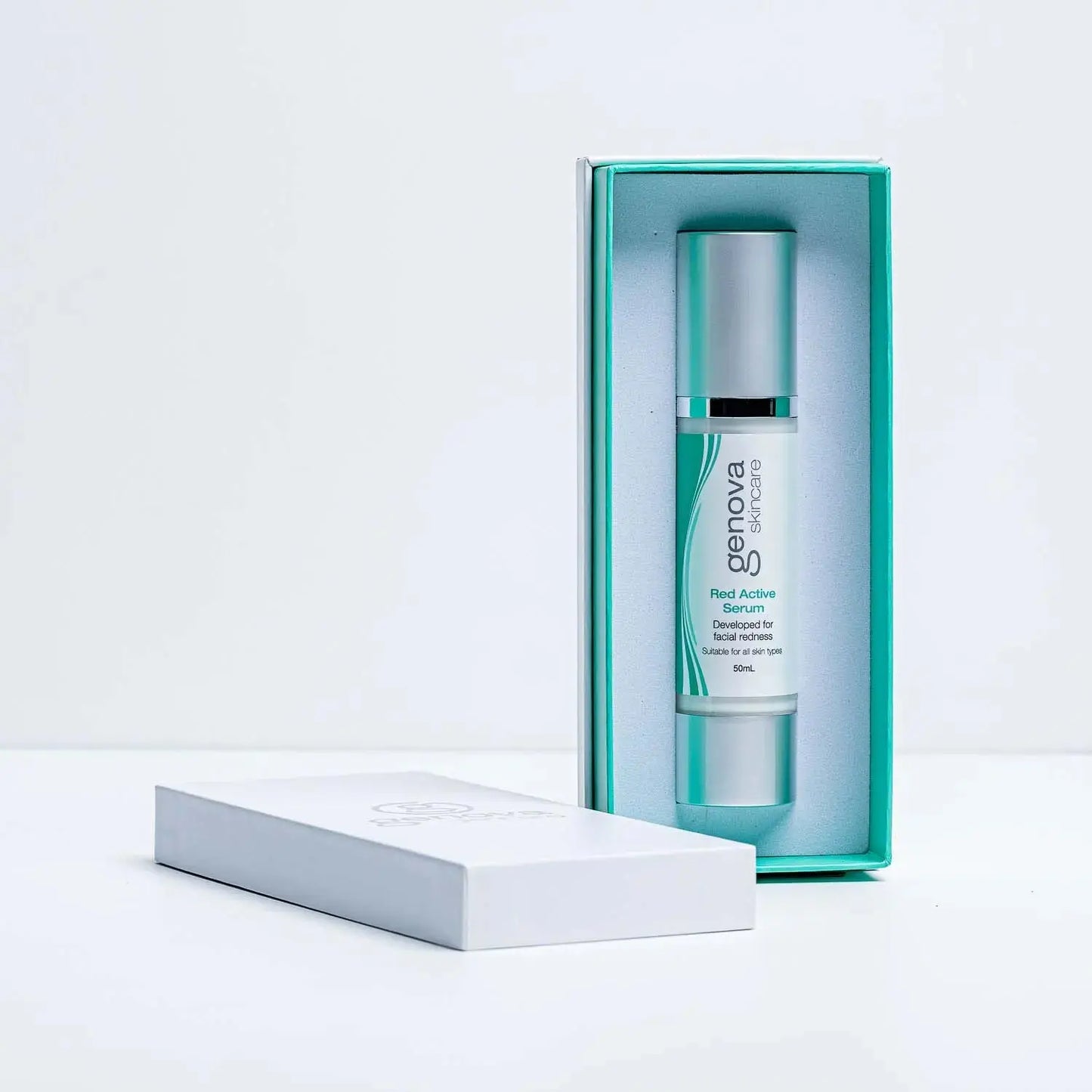
A good sunscreen protects red skin. It does not calm the redness that is already there. That is the gap Genova Red Active Serum is designed for: a light, twice-daily serum that goes on after cleansing and before your moisturiser and sunscreen.
It uses two peptides, Telangyn and Delisens, developed by their supplier for the look of facial redness and reactive skin, plus allantoin and rice bran oil. We do not quote supplier test figures, because they are not independent studies. It contains no acids or retinoids.
One honest note: it does contain a light fragrance. Patch test it first, and if fragrance has triggered your redness before, it is not for you.

50ml, made in Australia. A peptide serum for the look of facial redness. Contains fragrance. Free standard delivery over $50 and a 30 day money back trial.
Realistic expectations
Daily sunscreen may mean fewer sun-triggered flares within weeks. A calming serum takes longer: skin may look less red and reactive after 6–8 weeks of twice-daily use.
Neither will remove broken capillaries or stop hot flushes. Results vary from person to person.
Pros and cons of a mineral sunscreen for rosacea after 45
Pros:
- Often better tolerated by red, reactive skin
- Tinted versions can soften the look of redness
- Iron oxide tints add some visible light protection
Cons:
- Can leave a white cast or feel heavy
- Limited shade ranges in some tinted versions
- Still needs reapplying every two hours outdoors
Who this approach suits after 45, and who should see a doctor first
It suits you if sun, heat or wind make your face flush, or your skin stings with most sunscreens.
See a GP first if you have bumps, burning, eye irritation, a spot that will not heal, or redness that is spreading. Prescription creams for rosacea need a script. Our guide to rosacea creams you can and cannot buy over the counter explains the options.
Sunscreen myths that keep red skin red after 45
- Myth: the SPF in my foundation is enough. Reality: most people apply far too little foundation to reach the SPF on the label. Use a dedicated sunscreen underneath.
- Myth: I am indoors most of the day, so I can skip it. Reality: UVA passes through car and home windows, which is why sun damage is often more visible on the side of the face nearest the car window.
- Myth: sunscreen caused my rosacea flare. Reality: it is usually the formula, the heat or a stressed barrier, not sunscreen itself. Change the product before you give up the habit.
- Myth: I only need it in summer. Reality: in northern Australia the UV index reaches 3 or more in winter too. In the south, check the daily UV forecast, and remember wind and cold can add their own redness.
Sunscreen for rosacea: questions Australian women over 45 ask
What is the best Australian sunscreen for rosacea?
There is no single best one. Look for SPF 50+, broad spectrum, an AUST L number, and no fragrance or alcohol, then choose the texture you will wear daily.
Does sunscreen aggravate rosacea?
Sun is far more likely to aggravate rosacea than sunscreen. If a sunscreen stings, try a fragrance-free mineral formula instead of giving up.
What SPF is best for rosacea?
Cancer Council Australia recommends SPF 30 or higher. For sun-triggered redness, SPF 50+ gives extra protection.
Is mineral sunscreen better for rosacea?
Many people with rosacea find zinc oxide or titanium dioxide gentler. Some chemical sunscreens are fine too, so patch test and see.
What calms rosacea quickly?
A cool, damp cloth, getting out of the heat and avoiding hot drinks can settle a flush. Longer-term calm comes from a gentle routine and, where needed, GP-prescribed care.
Red face after 45: calm, protect, cover
Finding a sunscreen that does not sting can take a few tries, and that is normal. Once you find the one that suits your skin, it quietly does more for your redness than almost anything else in your bathroom cabinet.
Individual results vary. Genova Red Active Serum is a cosmetic designed to help skin look calmer and less red. It is not a sunscreen, does not treat rosacea and is not a substitute for advice from your GP, pharmacist or dermatologist. Brand names are mentioned as examples only; they are not affiliated with Genova Skincare, and formulas change, so always check the label.
Sources:
- Kamp E, Ashraf M, Musbahi E, DeGiovanni C. Menopause, skin and common dermatoses. Part 2: skin disorders. Clinical and Experimental Dermatology. 2022;47(12):2117-2122.
- Doolan BJ, Gupta M. Melasma. Australian Journal of General Practice. 2021;50(12).
- Maor D, Chong AH. Rosacea. Australian Family Physician. 2017;46(5).
- Cancer Council Australia. Sunscreen and sun protection guidance.
- Therapeutic Goods Administration. Sunscreens: regulation in Australia.
- DermNet. Rosacea: triggers and management.