
Sleep and Menopausal Skin: Why Poor Sleep Makes Skin Look Older After 45
By Simon MitchellQuick Summary:
Disrupted sleep is one of the most common menopausal symptoms, and the skin reads it before the mirror does. Falling estrogen and progesterone reduce the deep sleep stage that the skin relies on for overnight repair. After 45, this shows as dullness, puffy under-eye fluid, slower fade of yesterday's redness, and skin that reacts to things it used to tolerate. Skincare cannot replace sleep, but a peptide-led barrier routine can carry the skin through a disrupted stretch with fewer visible flare-ups.
It is 3:17am. You have been awake since two, the sheets thrown off because of the heat that woke you, then pulled back on when the room turned cold. The next morning your face looks like it has aged a week overnight. The foundation that worked on Tuesday now looks chalky.
Menopause is not just hot flushes and night sweats. It is also the mood that lifts and dips without warning, the joints that ache out of nowhere, the brain fog that loses words mid-sentence. Sleep, when it goes, makes every other symptom heavier, and often nobody warned you this is what menopause actually looks like.
The frustrating part is that the skin change after a broken night is not only cosmetic. The biology of disrupted sleep changes how the skin behaves, and after 45 it changes faster than at 30. This is part of the wider pattern in our overview of menopause skin changes after 45.
Why menopausal sleep falls apart after 45
Menopausal sleep falls apart because two hormones that helped you sleep, estrogen and progesterone, drop together. Estrogen regulated body temperature overnight; progesterone is mildly calming. When both decline, the result is more wakings, lighter sleep, and less of the deep stage where the body does most of its repair work.
A 2011 review in Maturitas reported that 40 to 60 percent of women in the menopausal transition experience significant sleep complaints, peaking in the first few years after the final period. Hot flushes can wake you four to twelve times a night, often without you remembering.
"I haven't had a proper night's sleep in eighteen months" is the line we hear most often. The body has shifted to a lighter, more fragmented pattern, and the cortisol curve the next day runs flatter and longer. That second part is where the skin starts to read it.
Tonight’s skin-saving sleep routine
- Keep the evening cleanse gentle.
- Avoid hot water.
- Apply serum to slightly damp skin.
- Seal with firming cream.
- Use SPF the next morning because tired skin often looks more uneven in daylight.
What disrupted sleep does to menopausal skin specifically
Disrupted sleep affects menopausal skin through three pathways at once: less collagen synthesis, more water loss across the barrier overnight, and prolonged cortisol elevation the next day, which drives skin inflammation. The combination is what makes a single broken week visible.
Deep sleep is the repair window for skin. Growth hormone peaks in the first deep-sleep cycles, blood flow rises, and fibroblasts (the cells that produce collagen) are most active. The estrogen baseline supports all of this, so in menopausal skin the deep-sleep window is doing more lifting on a smaller hormonal budget. The broader inflammatory pattern this triggers is covered in our piece on inflammaging in menopausal skin.
A 2017 study in Royal Society Open Science found that independent observers rated sleep-restricted faces as looking less healthy, less attractive and sadder than the same faces rested. The effect was visible after a single restricted night. For menopausal skin, the same restriction usually shows a stage earlier because the recovery margin is narrower.
Persistent insomnia, heavy snoring, waking gasping, or severe daytime fatigue should be assessed, because not all sleep disruption in midlife is hormonal.
How to tell sleep is the issue, not skincare or makeup
You can usually identify a sleep-driven skin shift by the timing. It appears within 24 to 72 hours of a broken stretch, looks worse in the late afternoon, and improves after one or two solid nights. Hormonal or structural changes do not move this fast.
The signals: puffiness around the eyes from fluid that has not fully drained, a greyer or duller complexion as microcirculation slows, redness from yesterday that has not yet faded, and the telltale sensitivity where a familiar serum suddenly stings. "My skin looks like an entirely different face" is how many readers describe it, and the comparison is fair because the surface really has changed within days. If products you used to tolerate are also starting to react, the overlapping pattern is covered in why familiar products suddenly sting in perimenopause.
What may help menopausal skin during a disrupted sleep season
Lifestyle affects the conditions your skin is living in. Skincare supports the surface your lifestyle is showing through. Sleep sets the overnight repair conditions; a peptide-led barrier routine then works on the surface those conditions produce.
Skincare cannot replace sleep, but a peptide-led barrier routine can support menopausal skin through a disrupted stretch with fewer visible flare-ups. The job in this season is to signal fibroblasts when the deep-sleep window is short, hold the barrier together overnight, and calm the inflammation prolonged cortisol drives the next day.
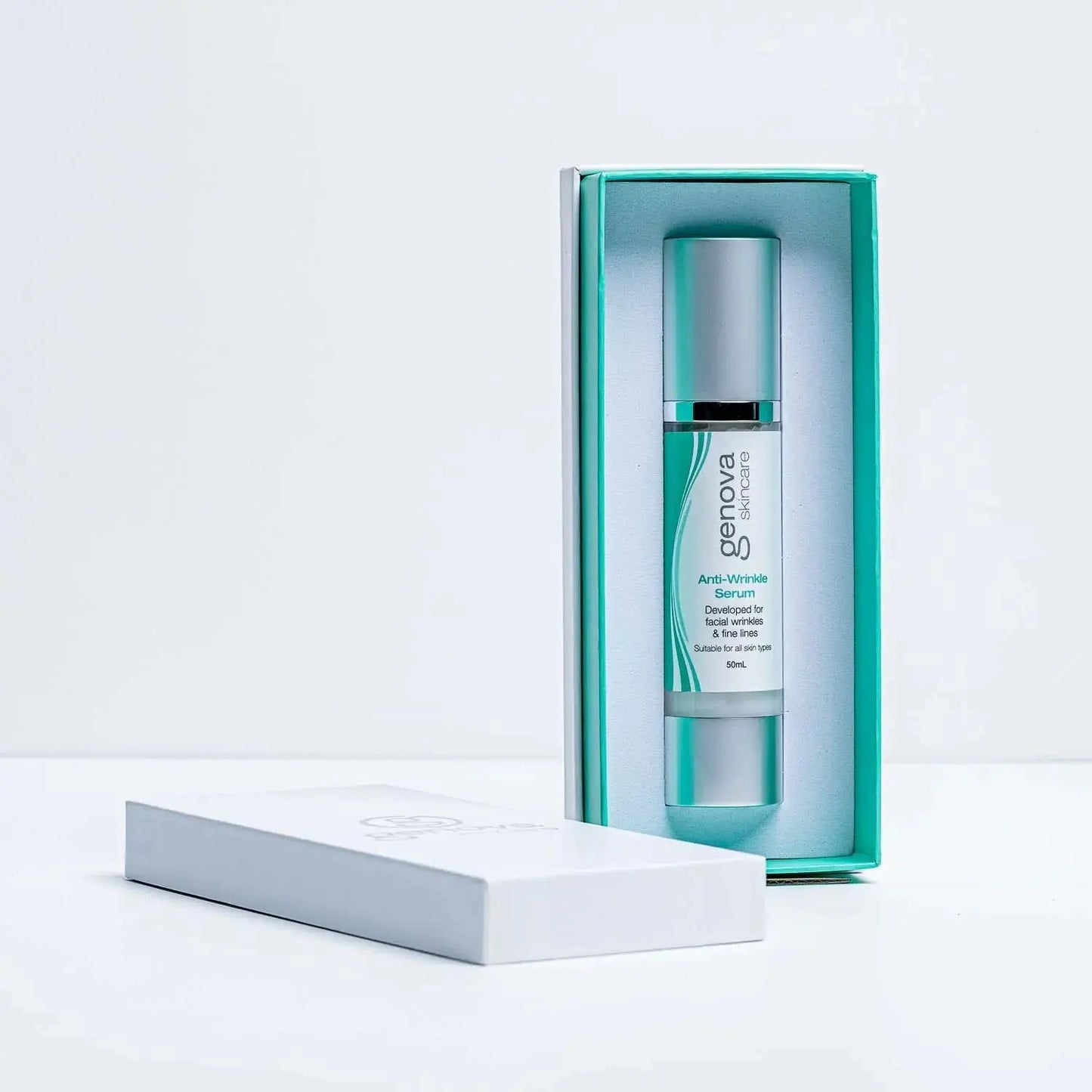
The Genova approach pairs three products. Active Foaming Cleanser preserves the overnight lipid layer. Anti-Wrinkle Serum uses peptide signalling that does not depend on a full deep-sleep window to work. Genova Firming Cream, made in Australia under strict quality-control standards, seals the layer in and slows overnight water loss.
A 2018 review by Lephart in Maturitas mapped the mechanism: as estrogen falls, ceramide content and barrier integrity decline together, and lipid-rich, peptide-supported routines partly offset both.
Realistic Expectations: A peptide-led routine may help calm the visible signs of a disrupted-sleep week within four to six weeks of consistent use. It will not replace sleep, and it cannot prevent the next night's hot flushes. If sleep has been broken for months, a conversation with your GP about menopausal sleep options is the more useful step. Skincare is the support layer here, not the structural fix. Results vary with consistency and individual skin condition.
Who it suits and who it does not
It may suit you if:
- You are 45 to 65, peri or post-menopausal, and your skin reads tired more often than it used to.
- You wake at least one or two nights a week and want a routine that supports the skin through it.
- You have already cut hot baths and screens before bed, and the skin is still showing the strain.
- You want a daily routine you can keep up with on the worst-sleep weeks.
It may not suit you if:
- Your sleep disruption is severe or has lasted months, and you have not yet seen a GP about it.
- You have diagnosed sleep apnoea or another sleep condition that needs proper care first.
- You are looking for a product that promises to undo the visible effects of years of disrupted sleep overnight.
- You are still on stripping cleansers or strong actives every night, which sleep-disrupted skin will not tolerate.
Strengths
- Peptide signalling continues working when the deep-sleep repair window is short.
- Barrier-first approach reduces reactivity, which is high during disrupted-sleep weeks.
- Non-stripping cleanser preserves the overnight lipid layer the skin needs.
- Routine takes two to three minutes morning and night, which matters when energy is low.
Limitations
- No skincare guarantees an outcome when sleep has been broken for months.
- Cannot reduce structural puffiness that is not fluid-related.
- Cannot replace a GP conversation about sleep itself or about menopausal sleep options.
- Visible improvement takes four to six weeks of consistent daily use.
How to use the routine on broken-sleep weeks after 45
Morning:
- Splash with cool water rather than hot, which settles overnight puffiness faster.
- Active Foaming Cleanser, 30 seconds, rinse.
- Anti-Wrinkle Serum on damp skin, two or three drops, press in.
- Firming Cream over the top, including under the eyes if puffiness is the main concern.
- Broad-spectrum SPF 50 plus.
Evening: the same gentle cleanse, Anti-Wrinkle Serum on slightly damp skin, Firming Cream as the final layer. If a hot flush wakes you and you sweat, splash cool water in the morning rather than re-cleansing at night, which would strip a barrier the skin spent the night rebuilding. If you are starting from a stripped-back routine, the 12-week pathway in our menopause skin reset sets out the same products in a slower introduction.
Does poor sleep actually age your face?
Yes, in the short term. A 2017 study in Royal Society Open Science found independent observers rated sleep-restricted faces as looking less healthy and more tired than the same faces rested. The effect eases within two to three solid nights.
How many nights of poor sleep before menopausal skin shows it?
Usually two to three nights. The visible signs (duller complexion, puffier eyes, more reactive skin) appear within 24 to 72 hours and are most obvious in the late afternoon.
Can a good skincare routine make up for lost sleep after 45?
No, not fully. A peptide-led routine may help calm the visible signs and support the skin through a disrupted season, but it cannot replace the repair work that happens during deep sleep itself.
Why is menopausal sleep loss worse for the skin than younger sleep loss?
Because the skin is already running on less estrogen support. The deep-sleep window in menopause is doing more lifting to hold collagen, barrier function and inflammation in balance, so when it shrinks, the gap shows faster.
Will HRT help my skin recover from sleep loss?
Possibly. If a doctor decides hormone therapy is appropriate, more stable sleep often follows and the skin tends to recover with it. This is a doctor conversation, not a skincare one.
Should I cut back on evening wine if my skin looks tired?
Often yes. Alcohol is a common menopausal sleep disrupter, especially in the three hours before bed. Reducing it tends to improve both sleep continuity and the skin's morning appearance.
References
- Polo-Kantola P. Sleep problems in midlife and beyond. Maturitas, 2011.
- Sundelin T, Lekander M, Sorjonen K, Axelsson J. Negative effects of restricted sleep on facial appearance and social appeal. Royal Society Open Science, 2017.
- Lephart ED. A review of the role of estrogen in dermal aging and the function of phyto-estrogens in skin care. Maturitas, 2018.
You are not imagining the change in the mirror after a broken week. The skin is doing its best on a tighter overnight budget, and that is real biology, not vanity. Until sleep stabilises, a calm peptide-led routine built around Anti-Wrinkle Serum and Firming Cream can carry menopausal skin through the disrupted weeks. If sleep has been broken for months, the GP conversation is the next step. Your skin will catch up when sleep does.
This article is for general information and is not a substitute for personalised advice from a qualified health professional. Genova products are cosmetics, not therapeutics, and are designed to support the appearance of menopausal skin. Individual results vary.