
How Long Does Menopausal Skincare Take To Work?
By Simon MitchellQuick Summary:
Peptide skincare for menopausal skin works on a slower timeline than the marketing suggests. Hydration changes appear in the first two weeks. Texture and tone shift at six to eight weeks. Firmness becomes visible around twelve weeks and continues building for months. After menopause, cell turnover slows from 28 days to 50 or 60, so any active asks more patience of the skin.
Most women do not stop because the product has failed. They stop because they are judging a collagen-supporting product on a hydration-product timeline.
You bought the serum three weeks ago.
You apply it twice a day. You stand under the bathroom light, turn your face one way then the other, and your jawline still looks soft. Nothing has changed. You are almost ready to put the bottle in the drawer with the others.
That feeling sits inside a larger one. Menopause is mood swings, broken sleep, a body that does not feel familiar. Skincare is one more thing that was supposed to help and seems not to be, and it still catches you off guard in the bathroom mirror.
You may be applying the right product on the wrong timeline. Peptide skincare does work on menopausal skin. The work happens underneath, and the visible part takes weeks longer than it did at thirty.
| Timeframe | What you may notice | What not to expect yet |
|---|---|---|
| Weeks 1–2 | Hydration, comfort, less tightness | Firmness |
| Weeks 3–6 | Smoother texture, calmer skin | Major lifting |
| Weeks 8–12 | Firmer look, softer lines | Full structural change |
| 3–6 months | Consolidation | Overnight transformation |
Why Menopausal Skin Takes Longer To Respond After 45
Skin turnover slows with age and slows further with menopause. In your twenties, the outer layer replaced itself every 28 days. After menopause, that cycle stretches to 50 or 60 days. The skin you see this morning was made roughly two months ago.
Fibroblasts (the cells that produce collagen and elastin) also become less active as estrogen declines. Research published in Maturitas by Lephart describes how estrogen receptors in skin cells help drive collagen production and barrier maintenance. When estrogen drops, the cells that respond to skincare signals are still working, just at a slower pace.
The skin barrier itself also changes. A ceramide profile study in Scientific Reports by Kendall and colleagues found measurable shifts in barrier lipids in menopausal skin, which affects how products penetrate and how long the barrier takes to rebuild.
How Peptides Work On Menopausal Skin And Why They Take Time
Peptides are not exfoliants. They are short chains of amino acids that signal skin cells to build more collagen, calm inflammation or strengthen the barrier. Research in Frontiers in Pharmacology by Errante describes how peptide signalling works in mature skin: the message is delivered topically, the cell receives it, and the response begins.
That response is cumulative. One application sends one signal. Twice-daily use over weeks sends thousands. Visible change appears when enough signals have produced enough collagen, elastin and barrier lipids to see the difference. Ten weeks of use does more than two. Peptides also tend to suit menopausal skin better than stronger actives, which is why many women prefer them to retinol or acids.
Comparing How Fast Different Approaches Work On Menopausal Skin
Hydration and humectants (hours to days)
Hyaluronic acid, glycerin and similar humectants pull water to the surface within hours. The change is real but temporary, because humectants do not change the underlying structure.
Surface exfoliation (2 to 4 weeks)
Glycolic, lactic and PHA acids work on the top layer of dead skin, brightening tone in a few weeks. Strong acids can irritate menopausal skin, so gentler options suit better. Exfoliation does not build collagen.
Peptide skincare (6 to 12 weeks)
Peptide serums and creams signal fibroblasts to produce collagen and support the barrier. Real change in firmness, texture and tone takes 6 to 12 weeks of twice-daily use, with continued improvement for months.
In-clinic options (4 to 8 weeks for first visible result)
Energy-based devices, microneedling and peels work faster but require sessions, downtime and maintenance. Many women combine peptide skincare with in-clinic care to support the surface between visits.
The Realistic Genova Skincare Timeline For Women Over 45
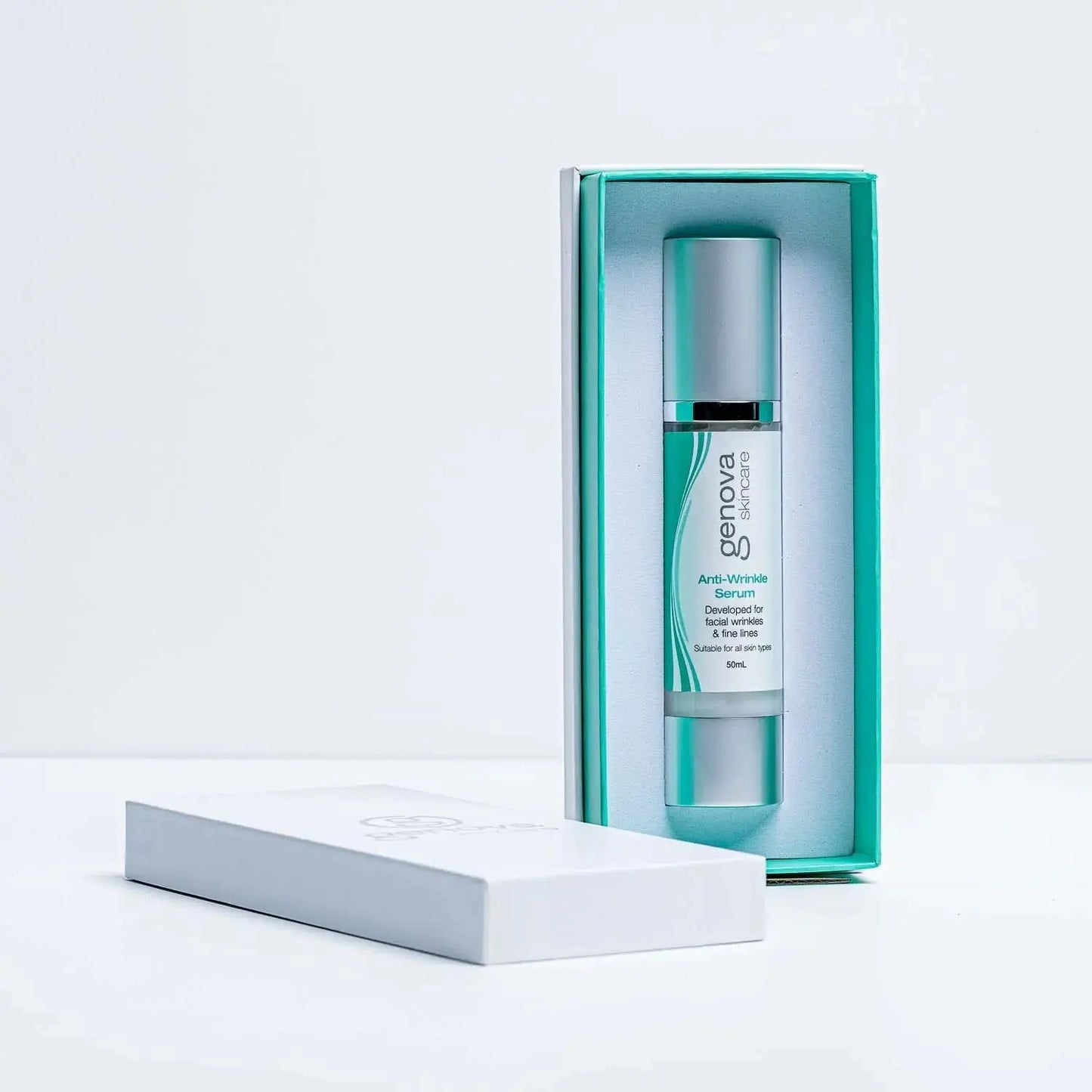
Genova products are formulated for Australian menopausal skin and made locally to strict quality-control standards. The peptide actives include Serilesine and Nocturshape in the Genova Firming Cream, and Matrixyl-family peptides in the Genova Anti-Wrinkle Serum. They are designed to support firmness and barrier function over time, not deliver an overnight change.
Here is the realistic timeline.
Weeks 1 to 2: skin feel improves. The surface holds water better, makeup sits more evenly, the tight feeling in the afternoon eases. The barrier is beginning to repair.
Weeks 3 to 6: tone and texture even out. Redness can settle. Small flaky patches reduce. Fine surface lines look softer because the skin underneath is more hydrated.
Weeks 8 to 12: firmness becomes visible. The jawline can look slightly more defined, the cheek area less crepey, the décolletage smoother. This is the point most women say "I think this is actually doing something."
3 to 6 months and beyond: the structural change consolidates. Collagen support is cumulative, so the routine continues to support firmness for as long as you stay with it.
Realistic Expectations: Peptide skincare may help improve the appearance of firmness, texture and tone in menopausal skin over 6 to 12 weeks of twice-daily use, with continued improvement for months. It cannot replace lost facial fat, lift loose hanging skin, or work overnight. Individual results vary based on age, baseline skin condition, sun exposure history and consistency of use.
Strengths And Limitations Of Peptide Skincare For Menopausal Skin
Strengths of a patience-based peptide routine for menopausal skin
- Builds structural support rather than surface gloss
- Lower irritation than retinol or acid routines, suits sensitive menopausal skin
- Suits the slower cell-turnover cycle of post-45 skin
- Cumulative: the longer you use it, the more it supports firmness
Limitations of skincare-only approaches for menopausal skin
- Cannot replace estrogen or reverse hormonal collagen loss
- Cannot lift loose hanging skin or remove deep folds
- Cannot restore lost facial fat volume
- Requires 6 to 12 weeks of twice-daily use before visible firmness change
- Results vary and depend on consistency, sun protection and lifestyle factors
How To Set Yourself Up For Patience With Menopausal Skincare
- Take a photo on day one. Same light, same time of day, same angle. Take another at week 6 and week 12. Memory is unreliable, photos are not.
- Apply twice a day, every day. Once a day halves the signal. Skipping nights pushes the timeline out.
- Use a small amount and press in. Peptides need contact with the skin, not pooled on top.
- Layer in the right order. Cleanser, peptide serum, firming cream, SPF in the morning. The layering order matters more than most women realise.
- Wear SPF 50+ every day. UV breaks down the new collagen you are trying to build. This is the single most important habit.
- Give it six weeks before deciding. If you stop at week three you will never see what week eight looks like.
For a structured start, the 12-week Menopause Skin Reset pathway walks through the same routine in phases.
Who Peptide Skincare Suits And Who It May Not Suit After 45
It may suit you if:
- You are in perimenopause or post-menopause and noticing slower firmness, fine lines or barrier sensitivity
- You want a low-irritation routine that can run twice a day
- You are willing to commit to 6 to 12 weeks before judging results
- You want a maintainable daily approach rather than a one-off fix
It may not suit you if:
- You expect overnight or two-week results
- You want structural lifting that only in-clinic options can deliver
- You are unlikely to use the products twice daily for several weeks
- You have severe sun damage or skin conditions that need a doctor-led plan
Frequently Asked Questions About Menopausal Skincare Timelines
How long does menopausal skincare take to work?
Hydration changes can appear in the first two weeks. Texture and tone shifts at six to eight weeks. Firmness becomes visible around twelve weeks and continues building for months with consistent twice-daily use.
Why do peptides take longer to work on menopausal skin?
Cell turnover slows from around 28 to 50 or 60 days after menopause, and fibroblast activity drops with lower estrogen. Peptides still signal correctly, but the cells respond at a slower pace, so visible change takes weeks longer than at 30.
Should I stop using my peptide serum if I see no change at four weeks?
Four weeks is too early to judge a peptide routine on menopausal skin. The structural changes that show up in the mirror typically appear between weeks 6 and 12. If your skin feels calmer or holds hydration better, the work is happening underneath.
Can I speed up the results from menopausal skincare?
Consistency speeds the timeline more than any extra product. Twice-daily application, daily SPF 50+, and avoiding things that disrupt the barrier (over-cleansing, hot water, strong actives stacked together) all help peptides work as fast as the biology allows.
How long should I keep using peptide skincare after I see results?
Peptide skincare works for as long as you use it. The collagen-supporting signal needs to be ongoing because the underlying biology of menopausal skin does not change. Most women stay on a peptide routine indefinitely.
Why does my friend see results faster than me on the same product?
Results vary based on age, baseline skin condition, sun exposure history, sleep, stress and consistency. Two women in the same age bracket can have different timelines from the same product. The biology is personal, not standard.
References
Lephart, E. D. (2018). A review of the role of estrogen in dermal aging and facial attractiveness in women. Maturitas, 117, 1-10.
Errante, F., Ledwoń, P., Latajka, R., Rovero, P., & Papini, A. M. (2020). Cosmeceutical peptides in the framework of sustainable wellness economy. Frontiers in Pharmacology, 11, 572923.
Kendall, A. C., Pilkington, S. M., Sassano, G., Rhodes, L. E., & Nicolaou, A. (2022). Menopause induces changes to the stratum corneum ceramide profile. Scientific Reports, 12, 21715.
The hardest part of skincare after 45 is not the science. It is staying with the routine through the weeks where nothing seems to be happening. Your skin is working on a slower clock, and that does not mean the products have failed. The cells underneath are doing the quiet work that will show up in the mirror two months from now. If you are starting fresh, the Firming Cream twice daily with the Anti-Wrinkle Serum underneath is the standard pairing. Bring the same patience to your skin that you bring to everything else you are managing.
Disclaimer: This article is for general information only and is not a substitute for personal professional advice. Results vary between individuals and depend on age, skin condition and consistency of use. If you have specific skin concerns or conditions, please consult a qualified skin specialist or your doctor.