
Sandpaper Skin After Menopause: Why Skin Feels Rough After 45
By Simon MitchellQuick Summary:
The fine, rough texture many women feel after 45 is not a dirt problem or a hygiene problem. It is accumulated dead cells sitting on top of a thinner, less lipid-rich barrier. Estrogen drops, cell turnover slows, sebum thins, and the surface holds onto what it used to shed. A gentle exfoliating routine paired with peptide and barrier support may smooth the surface over 4 to 12 weeks. Skincare cannot reverse decades of UV damage. Honest expectations make the routine more useful.
You ran your fingers across your cheek as you pressed moisturiser in at 9pm and felt something that was not there a year ago. The surface caught against your fingertip the way fine sandpaper does. Not dry exactly, because your skin felt hydrated underneath, but rough in a way that was not there at 35.
If you are also navigating broken sleep, the days that feel longer than they should, and a body that responds differently from the one you knew, please know your skin is part of the same picture. Estrogen helped your skin shed dead cells smoothly and produce the lipids that kept the surface even. When estrogen drops, both slow at the same time, and what was a smooth surface starts to feel rougher under your hand.
Sandpaper texture in mature skin is not a dirt problem or a hygiene problem. It is mostly accumulated dead cells sitting on top of a thinner barrier. Here is what is happening, and what may help.
Why Skin Feels Like Sandpaper After Menopause Over 45
The outer layer of your skin renews itself by shedding old cells from the surface as new cells push up from below. This process is called desquamation. In younger skin it happens evenly every 28 days or so, and the surface stays smooth because the cells leave on time.
Studies in Maturitas by Lephart describe how menopausal skin loses estrogen-driven moisture, sebum and barrier lipids. With less sebum to lubricate the surface and less barrier lipid in the spaces between cells, desquamation slows. Old cells stack up rather than shedding, and the surface becomes uneven under your hand.
Research in Scientific Reports by Kendall measured the stratum corneum lipid profile in pre- and post-menopausal women and found both fewer ceramides overall and a different ratio between subtypes. The mortar that should be helping the surface release dead cells is thinner. The bricks pile up.
Why Sun Damage Adds to Rough Texture in Mature Skin
Years of UV exposure produce small changes in the protein structure of the upper skin layer that show up as visible roughness in midlife. Even women who wore daily SPF in their forties usually have decades of earlier exposure stored in the surface. The roughness is a record of the years before SPF became routine, not a sign of poor care.
Australian women carry more of this story than most. Strong UV through childhood and the working years means the visible texture often shows earlier and more clearly here than overseas. In Australia, a persistent rough or scaly patch on sun-exposed skin should be checked, especially if it feels like sandpaper, crusts, bleeds, or keeps returning. For more on the broader picture, see Inflammaging in Menopause and What Happens to Your Skin Barrier During Menopause.
When rough skin needs checking
Rough texture after 45 is common, but not every rough patch is menopause-related. If the area is red, itchy, bleeding, crusting, rapidly changing, painful, one-sided, or does not improve with gentle care, seek advice from a qualified health professional. Conditions such as eczema, psoriasis, actinic keratoses, keratosis pilaris and dermatitis need different guidance.
Comparing Approaches to Rough Skin Texture for Menopausal Women Over 45
Four sensible categories to consider, depending on what you are willing to do.
Stripping cleansers and harsh scrubs (the old way)
Suits no one over 45. Foaming cleansers with high pH and gritty physical scrubs strip the surface, weaken the already-thinner barrier and trigger more roughness in defence. A common pattern in women who treated their forties skin like their teenage skin.
Gentle exfoliating acids 1 to 2 nights per week
A low-strength AHA or PHA helps the surface release the accumulated cells without stripping the barrier. Suits most menopausal skin at low frequency. More than 2 nights per week often does more harm than good after 45.
Peptide and barrier-led skincare (the daily default)
A gentle pH-balanced cleanser, a peptide serum and a lipid-rich moisturiser address the underlying mechanism: thinner barrier, slower turnover, less sebum. The most useful daily approach for sandpaper skin in menopause. May be paired with gentle acid 1 to 2 nights per week.
In-clinic options for stubborn texture
Microdermabrasion, gentle peels and energy-based options may help if texture remains an issue after a 12-week home routine. A qualified skin specialist can guide you on what suits your skin. Cost and outcomes vary by provider.
What May Help Build a Daily Routine for Menopausal Sandpaper Skin
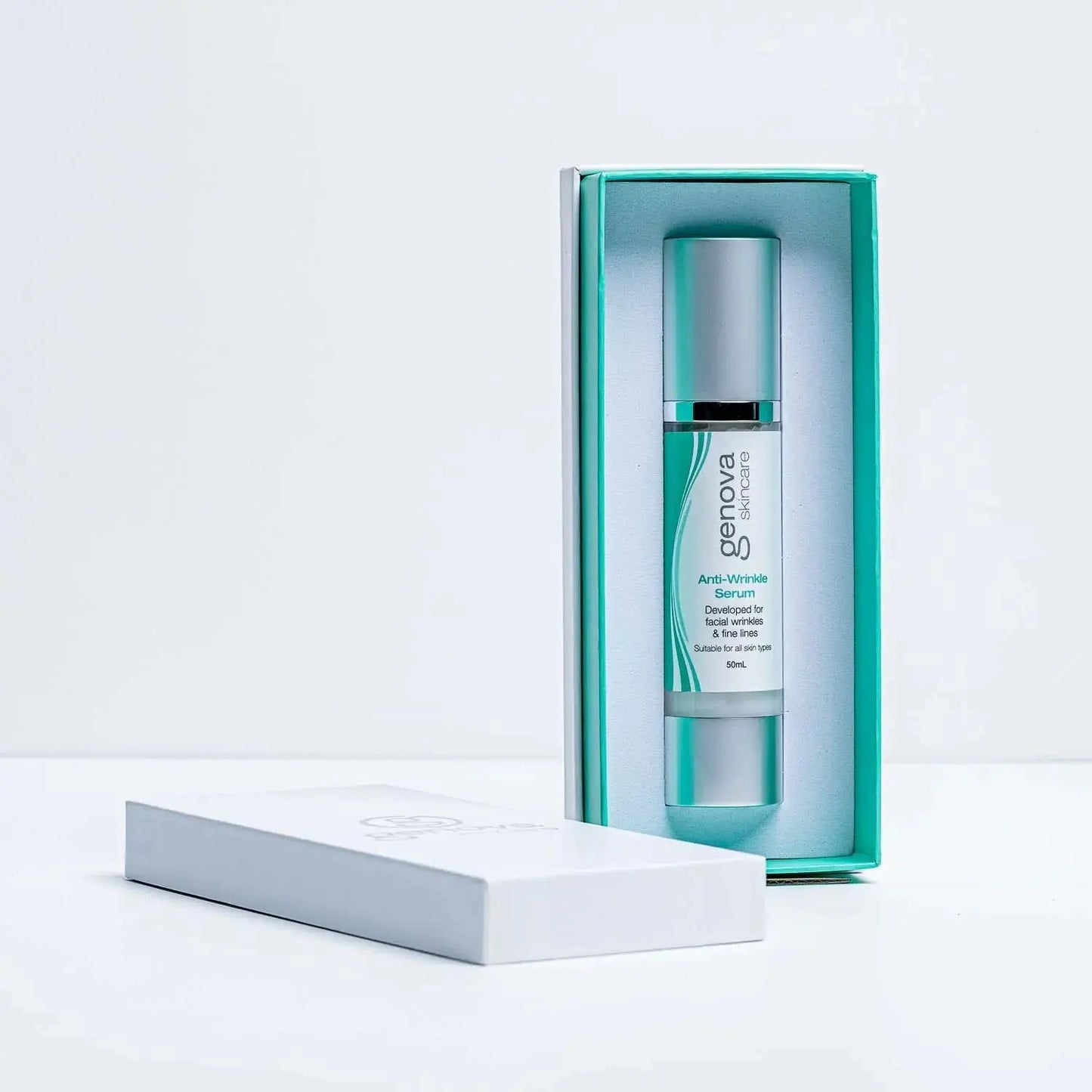
The most useful Genova starting point is the Genova Active Foaming Cleanser, a pH-balanced gentle cleanser that keeps the surface clear without stripping the lipids that hold the barrier in balance. Pair it with the Genova Anti-Wrinkle Serum on damp skin, which delivers peptide support to the cells underneath, and the Genova Firming Cream on top as a lipid-rich barrier moisturiser.
Add a low-strength glycolic or lactic acid serum 1 to 2 nights per week if the texture has not softened by week 4. For ingredient context, see the existing niacinamide for menopausal skin post for an alternative gentle multi-tasker, and the Menopause Skin Reset for a structured 12-week framework if your skin is also reactive.
The thinking is layered. A non-stripping cleanser leaves the lipids in place. A peptide serum supports the cells underneath. A lipid-rich cream replaces what menopause depleted. A gentle acid 1 to 2 nights per week helps the surface release the accumulated cells without flaring the barrier. SPF protects the gain.
Realistic Expectations: A peptide and barrier-led routine for sandpaper skin may show soft change at 4 weeks and more visible smoothness at 8 to 12 weeks. Skincare cannot reverse decades of UV damage, restore the cell turnover of your thirties, or replace estrogen. Daily SPF protects whatever surface gain you achieve. Individual response varies, and consistency outperforms intensity.
Strengths of a peptide and barrier-led approach for sandpaper skin
- Addresses the underlying mechanism: slowed turnover, less sebum, thinner barrier
- Reduces the rough-under-fingertip feel many women describe
- Suits sensitive menopausal skin that flares with stronger actives
- Compatible with gentle exfoliating acids 1 to 2 nights per week
- Visible improvement in surface smoothness at 8 to 12 weeks
Limitations of skincare alone for rough mature skin
- Will not reverse accumulated UV damage from earlier decades
- Will not restore the cell turnover speed of younger skin
- Will not replace estrogen or reverse menopausal skin changes
- Slower than in-clinic options for visible change
- Without daily SPF, surface gains are easily lost to further UV exposure
How to Apply a Daily Routine for Rough Menopausal Skin Step by Step
- Cleanse gently morning and night. Active Foaming Cleanser, lukewarm water, no scrubbing or hot water. Pat dry, leaving skin slightly damp.
- Press Anti-Wrinkle Serum onto damp skin. A few drops across face, jaw and neck.
- Layer Firming Cream over the top. Pea-sized amount, light pressing motions rather than dragging strokes.
- SPF 30 or higher every morning. Daily SPF protects the surface gain you are working toward.
- Add a gentle acid 1 to 2 nights per week from week 4. Glycolic, lactic or polyhydroxy acid (PHA) at low strength. Apply to clean skin, follow with Firming Cream over the top.
- Skip strong physical scrubs. Mature skin does not benefit from gritty exfoliation; chemical exfoliation at low frequency is gentler and more even.
Who This Routine May Suit in Menopausal Women
It may suit you if:
- Your skin feels rough under your fingertip in a way it did not at 35
- Foundation is sitting unevenly on cheeks or forehead
- Your routine is mostly hydration and the texture has not shifted
- You can apply twice daily for 8 to 12 weeks before judging progress
- You are committed to daily SPF
It may not suit you if:
- You expect skincare to reverse decades of UV damage
- You are unwilling to drop daily exfoliating acid
- You have an active skin condition needing professional input
- You skip daily SPF
- You have a confirmed condition like keratosis pilaris that needs separate guidance
Common Questions About Rough Skin Texture for Mature Skin
Why is my skin rough if it feels hydrated?
Hydration and texture are different. You can have well-hydrated skin underneath while old cells sit on the surface and feel rough to touch. The mechanism is slowed desquamation, not lack of water. A moisturiser alone will not change it.
Should I use a stronger acid or scrub more often?
Almost certainly not. Mature skin flares when over-exfoliated, which makes the texture worse. One to two nights of gentle acid per week is enough. Frequency matters more than strength after 45.
Why does the texture get worse in winter?
Cold dry air reduces the barrier's ability to hold moisture, sebum drops further, and indoor heating compounds it. The texture is the same; the surface dries on top of it. A richer cream and a humidifier overnight often soften the picture.
Can retinol help sandpaper skin?
It may, used carefully. Retinol speeds turnover and may smooth texture over weeks. Most menopausal skin tolerates low-strength retinol 1 to 2 nights per week. Daily retinol often makes the texture worse before better and is not the right starting point.
Is sandpaper texture the same as enlarged pores?
No. Pore appearance is about the wall around each opening sagging. Sandpaper texture is about cells sitting on the surface between pores. Both can happen at once, but they have different mechanisms and slightly different routines.
How long before I see a difference?
Soft change at 4 weeks, more visible smoothness at 8 to 12 weeks. The barrier and turnover rebuild slowly because cells move at their own pace. If nothing has shifted at week 12, an in-clinic conversation is the next step.
References
Lephart ED. Skin aging and oxidative stress: equol's anti-aging effects via biochemical and molecular mechanisms. Maturitas. 2018;117:68-75.
Kendall AC, Pilkington SM, Wray JR, et al. Menopause induces changes to the stratum corneum ceramide profile. Scientific Reports. 2022;12(1):21715.
If your cheeks have started catching on your fingertips when you press moisturiser in, please know this is one of the most common menopausal surface shifts and one of the most workable. A daily routine built around the Active Foaming Cleanser and the Firming Cream, with a gentle acid 1 to 2 nights per week, is one calm way to give the surface time to release the accumulated cells. Smoother skin under your hand is one piece you can quietly take back.
This article is for general information only and does not constitute personal advice. Genova products are cosmetics, not medicines. Results vary between individuals. If you have persistent skin changes, severe sensitivity or any concern about a skin condition, please seek personal advice from a qualified skin specialist.