
Red Flags To Avoid When Buying Menopause Skincare
By Simon MitchellQuick Summary:
Most disappointing menopause skincare purchases share a small number of warning signs that show up before you buy. Promises of overnight change, vague "peptide complex" wording with no peptide named, hero ingredients hidden at the bottom of the label, and influencer-only marketing are the four most reliable. Learning to spot them takes about a minute per product and saves the drawer full of bottles that never delivered.
You are in front of a skincare display, holding a small white bottle that costs $147. The box uses the word "menopause" three times. The back lists 41 ingredients, and the one the front is built around appears second-to-last. A small voice in the back of your head, the one that has been right before, says: this is going to end up in the drawer.
That moment is a tax on women in menopause. You are managing more than skin: the broken sleep, the joint stiffness, the body that does not feel like yours. You should not also need to be a marketing analyst to spend well.
Most disappointing purchases share the same handful of warning signs. Once you know them, you can spot them in about a minute, often without taking the bottle off the shelf.
| Red flag | Green flag |
|---|---|
| “Peptide complex” with no peptide named | Specific peptide names listed |
| “Visible lifting in 7 days” | 6–12 week expectation for firmness |
| No full ingredient list online | INCI visible on product page |
| Influencer proof only | Formulation logic and research shown |
| “Menopause” only on the front label | Formula built around dryness, barrier, firmness and sensitivity |
Why Spotting Red Flags Matters More For Women Over 45
Two things make menopause skincare more vulnerable to weak products than other categories. The first is biological. Research in Maturitas by Lephart describes how estrogen receptors in skin cells help drive collagen production and barrier maintenance, and how cellular activity slows when estrogen declines. The skin needs the formulation to do more, so an under-formulated product is more obviously inadequate at 55 than at 35.
The second is commercial. The menopause category is growing faster than most brands can keep up with, so anti-aging lines written for women in their 30s are being repackaged with the word "menopause" on the box. Red flags help you tell which boxes are which.
The Biggest Red Flags To Watch For In Menopause Skincare After 45
Eight warning signs cover most of what goes wrong. Two or three on the same product is enough to put it down.
1. Overnight change promises. Peptide skincare on mature skin works on a 6 to 12 week timeline. Anything promising visible firmness in a week is selling water retention, not collagen. The menopausal skincare timeline covers what is actually possible.
2. Vague hero ingredients. "Peptide complex" with no specific peptide named is a wrapper, not a formula. Effective peptides have names: Matrixyl, Serilesine, Nocturshape, Argireline, Eyeseryl. If the brand will not name them, that is a signal.
3. Hero ingredient at the bottom of the label. Ingredients are listed by concentration. If "retinol" or "niacinamide" appears after the preservative, it is trace and unlikely to do much. The ingredients that actually matter post covers what to look for.
4. Influencer-only marketing. If the brand's evidence is a paid partner's reel rather than its own published formulation logic, the marketing is doing the work the product cannot.
5. No INCI list without searching. Full ingredient lists should be findable on the box and the product page. A brand that hides the formula does not want you to compare it.
6. Promises that match a 30-year-old problem. "Fights the first signs of aging" was written for women noticing their first fine lines. On a 55-year-old, the actives behind that claim usually underperform.
7. No statement of what the product cannot do. Brands that publish limits tend to be more honest about what is in the bottle. Silence on limits is its own signal.
8. Imported formulations sold as "for Australian skin". Formulations written for a European or US climate often do not suit higher UV, harder water and the year-round dryness many parts of Australia experience.
Comparing Common Marketing Tactics In Menopause Skincare
Promise-led marketing
The front of the box does the heavy lifting. Words like "lifted," "younger," "renewed," "smoother in days." The bottle behind the words rarely matches the claim. Easy to spot once you look past the typography.
Celebrity or influencer-led marketing
A trusted face does the recommending. Useful as an awareness signal, weak as a buying signal because the partnership is usually paid. Cross-check anything recommended this way against the ingredient list.
Hero-ingredient marketing (genuine and shallow)
The bottle is built around a named ingredient. Genuine versions list the specific molecule, concentration and mechanism. Shallow versions use the family name with no detail. The depth of the description tells you which you are looking at.
Evidence-led marketing
The brand publishes its formulation logic, the research behind its choices, and the limitations of what skincare can do. Slower and less glamorous than the other three, but the most reliable predictor that the product will perform as described.
How Genova Avoids The Common Red Flags For Menopausal Skin Over 45
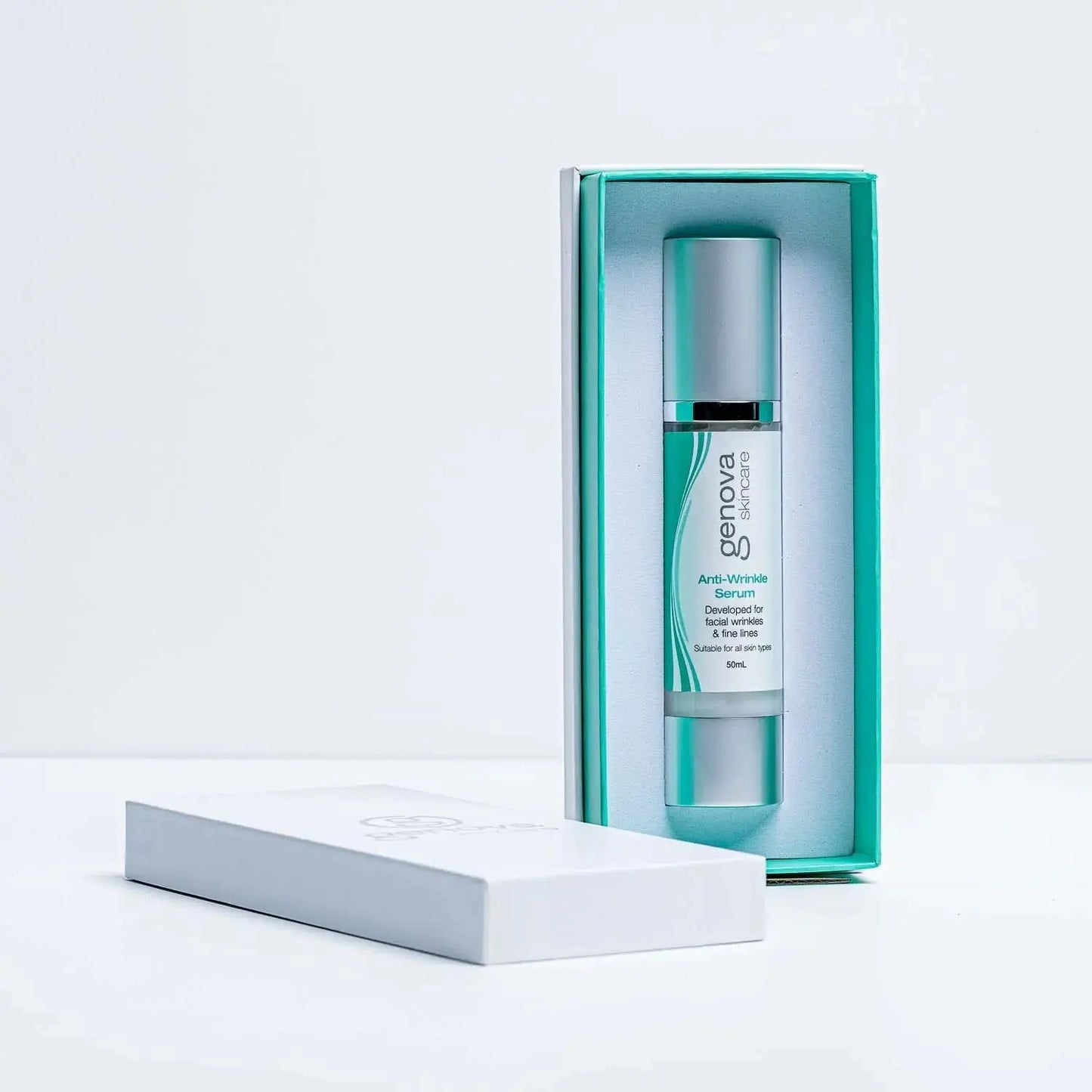
Genova products are formulated for Australian menopausal skin and made locally to strict quality-control standards. The peptide actives are named on the label and in the marketing: Serilesine and Nocturshape in the Genova Firming Cream, Matrixyl-family peptides in the Genova Anti-Wrinkle Serum, and Eyeseryl, Eyedeline and Snap-8 in the Perfecting Eye Serum. The Active Foaming Cleanser sits at the start of the routine without stripping the lipids the rest is supporting.
Timelines are stated in the realistic range, not the marketing one. Research in Frontiers in Pharmacology by Errante describes how peptide signalling works in mature skin, and that science underpins what the products are designed to do.
Realistic Expectations: A red flag checklist improves your odds of buying well, but does not promise any single product will suit your skin. A good routine for menopausal skin may improve hydration in 2 to 4 weeks, texture by week 6 to 8, and firmness by week 12. It cannot replace lost facial fat, lift loose hanging skin, or undo years of UV damage. Individual results vary.
Strengths And Limitations Of A Red Flag Checklist For Women Over 45
Strengths of a red flag approach for menopausal skin
- Filters most weak products in under a minute
- Reduces the cost of trial-and-error over time
- Builds your own confidence in what to walk away from
- Travels with you across brands, price points and categories
- Aligns spending with formulations that actually match menopausal biology
Limitations of any red flag checklist for menopausal skin
- Cannot tell you the concentration unless the brand publishes it
- Cannot predict how your specific skin will respond to a finished formula
- Cannot replace a patch test for sensitive or reactive skin
- Cannot substitute for professional input on a skin condition
- Cannot speed up the underlying timeline of mature skin
How To Spot A Menopause Skincare Red Flag In Under 60 Seconds After 45
- Read the timeline claim on the front. Anything under 6 weeks for firmness is not biology, it is marketing.
- Turn the box over. Look for specific peptide names, ceramides, niacinamide. No specifics means no real signal layer.
- Find the hero ingredient on the INCI list. After the preservative is trace concentration.
- Check the brand source. If the loudest evidence is an influencer reel rather than the brand's own formulation logic, the marketing is overcompensating.
- Look for what the product says it cannot do. Silence on limits is a flag.
- Compare to the buying framework. The how to choose menopause skincare hub covers the wider decision.
Who Should Use A Red Flag Checklist For Menopause Skincare After 45
It may suit you if:
- You have wasted money on products that did not deliver
- You feel overwhelmed by the volume of menopause skincare on shelves
- You want a quick filter you can run in the aisle or on a product page
- You are tired of buying based on packaging or influencer recommendation
- You are in perimenopause or post-menopause and want to invest well
It may not suit you if:
- You enjoy trying new products on a regular basis and do not mind misses
- You prefer to buy on packaging, fragrance or recommendation alone
- You have a doctor-led plan for a skin condition you should not adapt
- You want a single hero product rather than a small considered routine
Frequently Asked Questions About Menopause Skincare Red Flags After 45
Are all expensive menopause skincare products well formulated?
No. Price often reflects packaging, marketing and brand prestige rather than active concentration. A mid-priced product from a transparent manufacturer often outperforms a luxury equivalent on results.
If a brand uses the word "menopause" on the box, is the product for menopausal skin?
Not necessarily. The word is unregulated, and many products carrying it were repackaged from anti-aging lines written for women in their 30s. Look at the named actives, not the front of the box.
How seriously should I take "dermatologically tested" claims?
These claims usually mean the product was patch tested, which is a low bar. They do not tell you whether the actives are present at useful concentrations or whether the formula suits menopausal skin.
Is it a red flag if a product has many actives at once?
It can be. Five or six "hero" actives in one bottle usually means each sits at a tiny concentration. A small routine of two or three focused products usually outperforms one product claiming everything.
Can I trust user reviews for menopause skincare?
Use them as one input. Reviews are most reliable for tolerability and texture, less reliable for firmness because most reviewers stop before the 12-week timeline. Filter for verified buyers over 45.
What is the single biggest red flag to watch for?
Promises of visible change in less than two weeks. Mature skin does not move that fast biologically, so anything claiming it is selling marketing, not biology.
References
Lephart, E. D. (2018). A review of the role of estrogen in dermal aging and facial attractiveness in women. Journal of Cosmetic Dermatology, 17(3), 282–288.
Errante, F., Ledwoń, P., Latajka, R., Rovero, P., & Papini, A. M. (2020). Cosmeceutical peptides in the framework of sustainable wellness economy. Frontiers in Chemistry, 8, 572923.
The wall of menopause skincare is loud on purpose, built to make decisions hard and to let hope do the work the formula sometimes cannot. A short red flag list quietens the noise, and a minute on the back of the box saves the drawer of bottles that never delivered. If you are starting fresh, the Firming Cream twice daily with the Anti-Wrinkle Serum underneath is the standard pairing.
Disclaimer: This article is for general information only and is not a substitute for personal professional advice. Results vary between individuals and depend on age, skin condition and consistency of use. If you have specific skin concerns or conditions, please consult a qualified skin specialist or your doctor.