
Peptide Skincare Results By Month For Women Over 45
By Simon Mitchell
Quick Summary:
Peptide skincare changes show up in a predictable order on menopausal skin. Month 1: hydration and skin feel. Month 2: texture and tone. Month 3: firmness becomes visible. Months 4 to 6 and beyond: the structural change consolidates and continues to build. Knowing what to look for each month makes the difference between giving up at week 4 and recognising the slow shift that is actually underway.
| When | What to look for | What not to judge yet |
|---|---|---|
| Week 4 | Comfort, hydration, less tightness | Firmness |
| Week 8 | Smoother texture, calmer tone | Lifting |
| Week 12 | Firmer-looking cheeks, jawline, décolletage | Full structural change |
| Month 6 | Consolidated firmness, more even tone | Overnight transformation |
It is week five. You have been using the routine morning and night for over a month. You stand at the bathroom mirror and turn your face slowly, looking for the change. Your skin feels different. Better, maybe. But is that real, or are you imagining it because you want it to be?
That uncertainty is one of the quieter frustrations of menopausal skincare. You are managing broken sleep, mood shifts, a body that does not feel like yours. You have been patient and done the work, and you cannot exactly ask anyone whether your face looks different to last month.
There is a way to track this carefully. Peptide changes happen in a specific order, and knowing what to look for each month is the difference between abandoning a routine at week 4 and recognising the slow shift already underway.
Why Menopausal Skin Changes On A Monthly Timeline After 45
Mature skin runs on a slower clock. The outermost layer turns over every 50 to 60 days after menopause, compared with about 28 days in your twenties. Research in Maturitas by Lephart describes how estrogen receptors in skin cells help drive collagen production, and how cellular activity slows when estrogen declines.
Peptides work by signalling the cell rather than scrubbing the surface. Research in Frontiers in Chemistry by Errante describes how peptide signalling works in mature skin: the cell receives the message and the response begins, but the visible result depends on how fast the cell can act. On menopausal skin, that pace is slower.
The barrier rebuilds faster than collagen, which is why hydration responds first. A ceramide study in Scientific Reports by Kendall and colleagues found measurable shifts in barrier lipids in menopausal skin. Firmness comes last because new collagen takes longest to lay down in the dermis.
Month By Month Peptide Skincare Results For Menopausal Skin Over 45
Weeks 1 to 4: hydration and skin feel. The first thing to shift is how your skin feels. The surface holds water better, the tight afternoon feeling eases, makeup sits more evenly, small flaky patches reduce. There is usually no visible change in firmness or fine lines yet. If your skin feels calmer by week 4, the routine is working underneath.
Weeks 5 to 8: texture and tone. Around week 6 the texture begins to even out. Redness can settle, reactivity reduces, fine surface lines look slightly softer. You may catch your reflection in passing and think it looks fresher without being able to say why. This is the "I think it might be doing something" stage.
Weeks 9 to 12: firmness becomes visible. Month 3 is when the structural change starts to show. The jawline can look slightly more defined, the cheek area less crepey, the décolletage smoother. This is the milestone the marketing usually promises in 4 weeks and that actually arrives in 12.
Months 4 to 6 and beyond: structural change consolidates. Collagen support is cumulative. Most women notice the most visible shift between months 3 and 6, and the routine continues for as long as it stays in place. Pigmentation, the slowest change, may begin to even out around month 6 with daily SPF. Without daily SPF 50+, pigmentation and collagen breakdown continue to be triggered faster than any peptide routine can visibly correct.
If you want the full routine structure, follow our 12-week menopause skin reset.
Comparing How Different Skin Concerns Respond Month By Month In Menopausal Skin
Hydration and barrier feel (weeks 1 to 4)
The fastest change. Skin feels more comfortable, less tight, less reactive. Surface looks slightly plumper because hydrated skin reflects light better. Easy to miss if you are scanning for firmness.
Texture and tone evenness (weeks 5 to 8)
Redness settles. Flaky patches reduce. Small bumps smooth out. Skin looks more even in tone, especially across the cheeks. Fine surface lines soften.
Firmness and elasticity (weeks 9 to 16)
The slowest change to appear and the one most worth waiting for. Jawline definition, cheek lift and décolletage smoothness shift gradually as new collagen builds. Continues improving for months with consistent use.
Pigmentation and uneven tone (months 3 to 6 and beyond)
The slowest concern to respond because pigmentation sits deeper. Daily SPF 50+ matters more than the active for this one. Visible change is subtle rather than dramatic.
How To Track Your Genova Skincare Progress Each Month After 45
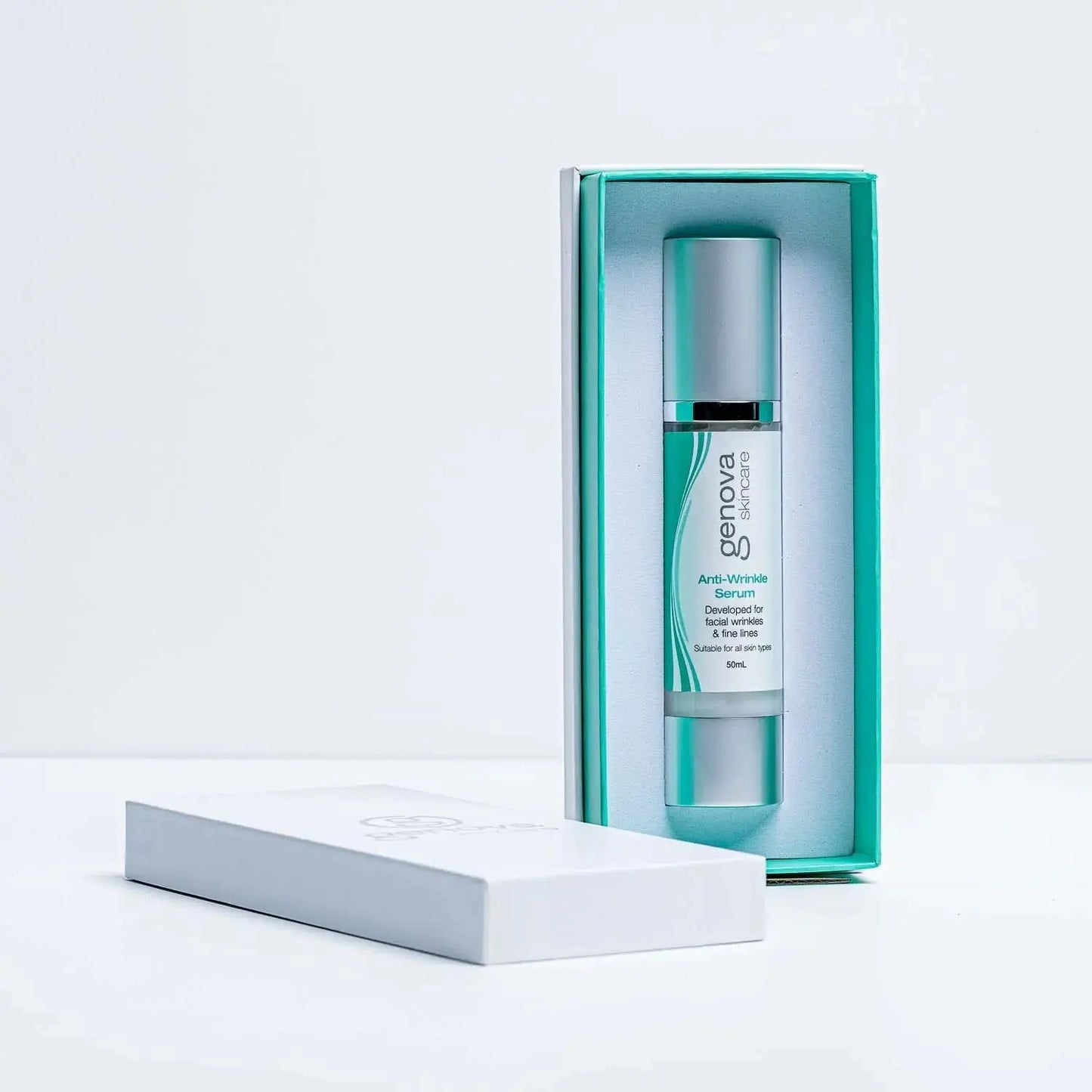
Genova products are formulated for Australian menopausal skin and made locally to strict quality-control standards. The peptide actives include Serilesine and Nocturshape in the Genova Firming Cream, and Matrixyl-family peptides in the Genova Anti-Wrinkle Serum. The basic routine is cleanser, peptide serum, firming cream, SPF in the morning.
To track progress, decide what to look for at each milestone. Week 4: skin feel and surface comfort. Week 8: texture and tone. Week 12: firmness in the jawline and cheek area. The full application guide covers the correct technique. If you have been using the routine for 12 weeks and seen no change, the science behind peptides post covers what is actually possible and what is not.
Realistic Expectations: The monthly timeline holds for most women but individual results vary based on age, baseline skin condition, sun exposure history, sleep, stress and consistency of use. Peptide skincare may help improve the appearance of firmness, texture and tone over 6 to 12 weeks of twice-daily use. It cannot replace lost facial fat, lift loose hanging skin, or undo years of sun damage. If nothing has shifted at week 12 of consistent use, the five common mistakes post covers the most likely reasons.
Strengths And Limitations Of A Month-By-Month Tracking Approach For Menopausal Skin
Strengths of tracking menopausal skincare progress monthly
- Compares your skin against your own baseline, not someone else's filter
- Catches the early hydration shift that is easy to miss
- Stops the "is it working" cycle from spiralling at week 4
- Gives a real basis for deciding whether to continue
- Builds awareness of how your skin responds over time
Limitations of monthly tracking for menopausal skin
- Photos cannot capture how the skin feels, only how it looks
- Lighting, angle and time of day can mask real change between photos
- The slowest changes (firmness, pigmentation) take months to show in a single image
- Cannot speed up the underlying biological timeline
- Comparison too often can amplify small day-to-day variation
How To Photograph Your Skin For An Accurate Month-By-Month Comparison After 45
- Day 1: Baseline photo. Natural daylight, no makeup, hair pulled back. Front, left side, right side.
- Same spot. Same window, same angle, same time of day. Mid-morning natural light is most consistent.
- Same expression. Neutral face, no smile. Small expression differences read as firmness differences.
- Same camera distance. Phone arm's length, lens at face height.
- Repeat at week 4, week 8 and week 12. Compare side by side, not from memory.
- Look for what is on the list for that month. Hydration at week 4, texture at week 8, firmness at week 12. Trying to spot everything at once usually leads to seeing nothing.
Who Should Track Monthly Progress In Menopausal Skincare After 45
It may suit you if:
- You tend to give up on products at week 3 or 4
- You want a basis for deciding whether to continue a routine
- You find it easier to compare side by side than rely on memory
- You are in perimenopause or post-menopause and want to understand how your skin responds
It may not suit you if:
- You find frequent photography stressful or critical of your appearance
- You would compare daily rather than monthly, which amplifies variation
- You expect dramatic change in 2 to 4 weeks regardless of evidence
- You prefer a "set it and forget it" approach
Frequently Asked Questions About Monthly Skincare Progress In Menopausal Women
How often should I take progress photos?
Once a month is enough. Day 1, week 4, week 8 and week 12 covers the main milestones. Daily photos amplify small variation and make real progress harder to see.
What if I see no change at month 1?
Month 1 changes are usually about how the skin feels rather than how it looks. If your skin feels calmer or more hydrated, the routine is working underneath. Visible change typically arrives at month 2 or 3.
Can stress or hormones change what I see month to month?
Yes. Sleep, stress, hormonal shifts and Australian sun exposure all affect skin appearance week to week. Looking at the trend across months gives a more reliable read.
What is the most reliable sign that the routine is working?
How the skin feels is more reliable than how it looks in the first 8 weeks. Calmer, less reactive, less tight, more hydrated skin is the early signal that the barrier and cells are responding.
Should I expect to see firmness change at month 3?
Most women see some firmness change between weeks 8 and 12 with twice-daily use. The change is usually subtle and builds further between months 3 and 6.
If I miss a few weeks, do I have to start the timeline over?
No. The signals already sent contributed to the response. Restart the routine and the timeline picks up.
References
Lephart, E. D. (2018). A review of the role of estrogen in dermal aging and facial attractiveness in women. Maturitas, 117, 1-10.
Errante, F., Ledwoń, P., Latajka, R., Rovero, P., & Papini, A. M. (2020). Cosmeceutical peptides in the framework of sustainable wellness economy. Frontiers in Chemistry, 8, 572923.
Kendall, A. C., Pilkington, S. M., Sassano, G., Rhodes, L. E., & Nicolaou, A. (2022). Menopause induces changes to the stratum corneum ceramide profile. Scientific Reports, 12, 21715.
The slowest part of menopausal skincare is also the part that matters most. The changes you are looking for are real, they just arrive in a different order than the marketing tends to imply. If you track what is on the list for each month rather than scanning for everything at once, you give yourself a real chance of seeing the shift as it happens. If you are starting fresh, the Firming Cream twice daily with the Anti-Wrinkle Serum underneath is the standard pairing. Trust the timeline.
Disclaimer: This article is for general information only and is not a substitute for personal professional advice. Results vary between individuals and depend on age, skin condition and consistency of use. If you have specific skin concerns or conditions, please consult a qualified skin specialist or your doctor.