
How to Choose Menopause Skincare That Actually Works After 45
By Simon Mitchell
Quick Summary:
Most menopause skincare on shelves was written for a 35-year-old, not a 55-year-old, which makes choosing well harder than it should be. A short buying framework cuts through most of the noise: look for ingredients with published mechanism, transparent formulation, compatibility with menopausal skin, realistic timelines, and a manufacturer that publishes its evidence. Apply it to anything you are considering and the shortlist shrinks fast.
| If your main concern is… | Read this next |
|---|---|
| Wrinkles and firmness | Peptide skincare results by month |
| Dryness and barrier weakness | Best skincare routine for menopausal skin |
| Pigmentation | Brightening serum / menopausal pigmentation article |
| Clinic treatments | Skincare and clinic care hub |
| Starting from scratch | 12-week Menopause Skin Reset |
It is Saturday morning in Mecca. You are standing in front of a wall of menopause skincare. Four serums claim peptides, three creams claim collagen, two products say "for hormonal skin." A 23-year-old assistant offers help and you smile, because the question you actually have is bigger than any single product on the shelf.
You are managing more than skin. The broken sleep, the joint stiffness, the body that does not feel like yours. You do not have the energy to read every box, and you do not want to spend $180 on something that ends up in the bathroom drawer with the others.
Choosing menopause skincare is simpler than the aisle makes it look. The marketing is loud, the science underneath is much smaller and clearer, and a short buying framework filters most of the noise.
Why Choosing Menopause Skincare Is Harder For Women Over 45
Two things make this harder than it should be. The first is biological. Research in Maturitas by Lephart describes how estrogen receptors in skin cells help drive collagen production and barrier maintenance, and how cellular activity slows when estrogen declines. The skin you had at 35 is not the skin you have now, so the products that worked at 35 often will not deliver the same result.
The second is commercial. Most menopause skincare on shelves was repackaged from anti-aging lines written for women in their 30s. Boxes use the words "menopause," "hormonal," and "mature" without specifying what is in the bottle that matches the biology, and the result is a shopper who feels she should be able to tell the difference and cannot. A buying framework solves the second problem by changing the experience from guessing to evaluating.
What To Look For When Buying Menopause Skincare After 45
Five questions cut through most marketing. Apply them to anything you are considering and the shortlist usually shrinks fast.
1. Does the ingredient have a published mechanism? Peptides, ceramides, niacinamide and retinoids all have decades of research behind them. If the hero ingredient is a proprietary blend with no published evidence, you are paying for marketing. The science of peptides on menopausal skin covers the most commonly used actives.
2. Is the formulation transparent? Full ingredient lists (INCI) should be available without hunting, and concentrations matter for actives like retinol, niacinamide and vitamin C. If the brand will not say what is in the bottle in real terms, that is a signal.
3. Is the formulation compatible with menopausal skin? Menopausal skin has a more alkaline surface, a thinner barrier and slower cell turnover. Stripping cleansers and high-strength acids that suited skin at 30 often irritate skin at 55. The best skincare routine for menopausal skin covers what a compatible routine looks like.
4. Are the timelines realistic? Peptide skincare on mature skin works on a 6 to 12 week timeline, not a 7 day one. The menopausal skincare timeline pillar maps what changes when. A product promising visible firmness in 7 days is selling water retention, not collagen.
5. Does the manufacturer publish its evidence? Brands that publish their formulation logic and the limitations of what skincare can do are easier to trust than brands leaning on celebrity endorsements. The skincare and clinic care hub covers when skincare is the right layer and when an in-clinic option is the better fit.
Comparing Common Buying Strategies For Menopause Skincare Over 45
Influencer-led buying
Picking what someone you follow recommends. Fast and social, but the influencer is usually a paid partner and may not match your age, skin type or budget. Works occasionally, expensive when it does not.
GP or skin specialist recommendation
Reliable for skin condition concerns like rosacea, eczema or significant pigmentation. Specialists know high-strength actives well, less so the latest cosmeceutical peptides. Best paired with a daily routine you choose yourself.
Ingredient-led research
Reading what is in the bottle, checking the mechanism, comparing concentrations across brands. Slower but more accurate, and tends to produce the longest-lasting purchase satisfaction.
Price-led buying
Cheapest or most expensive, depending on the day. The cheapest option often skips actives. The most expensive often pays for packaging and marketing. Neither correlates reliably with results on menopausal skin.
How Genova Skincare Is Designed For Menopausal Skin Over 45
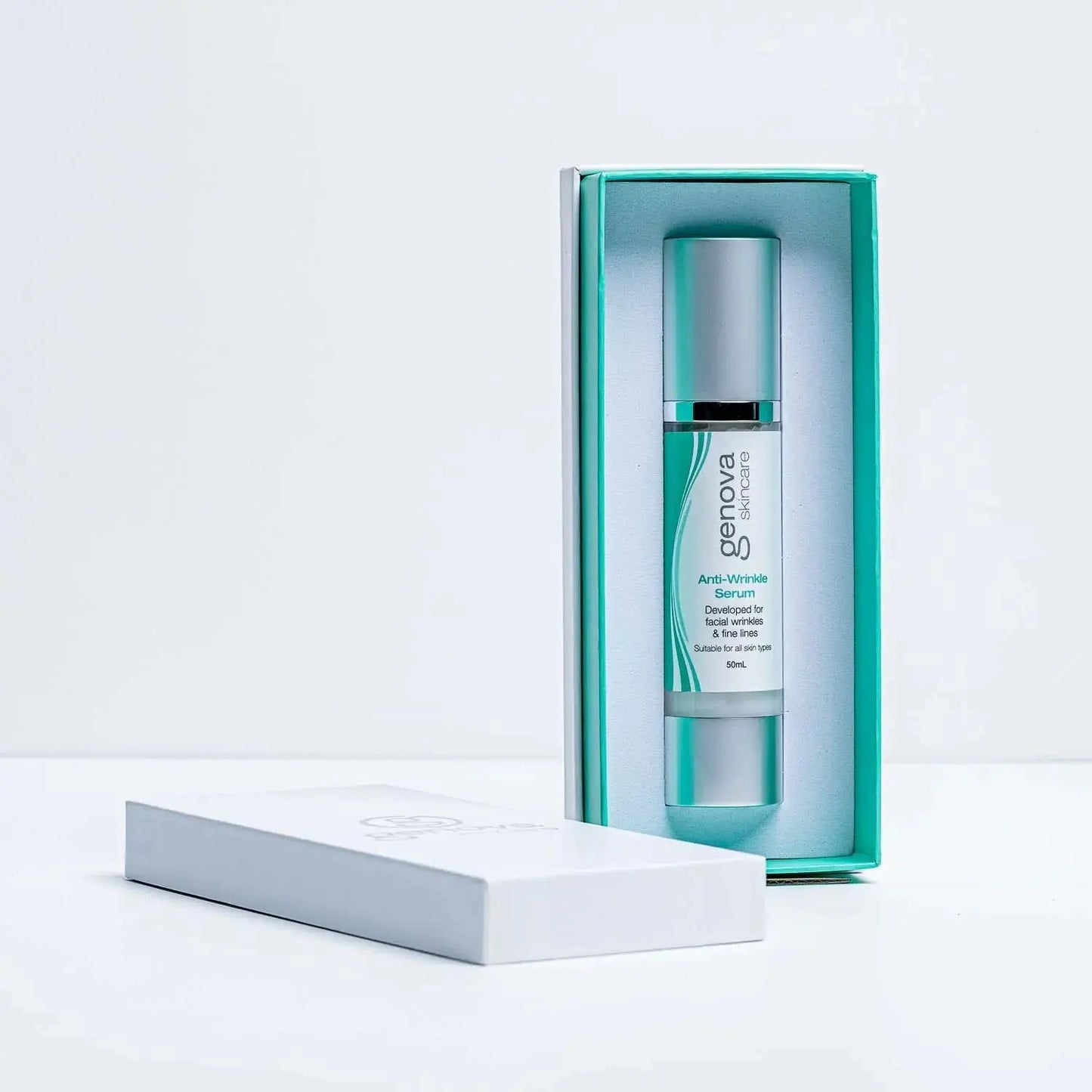
Genova products are formulated for Australian menopausal skin and made locally to strict quality-control standards. Local manufacture means formulations written for the Australian climate, UV load and water profile rather than adapted from a European or US base. The peptide actives include Serilesine and Nocturshape in the Genova Firming Cream, Matrixyl-family peptides in the Genova Anti-Wrinkle Serum, and Eyeseryl, Eyedeline and Snap-8 in the Perfecting Eye Serum. Research in Frontiers in Pharmacology by Errante describes how peptide signalling works in mature skin.
The full routine includes the Active Foaming Cleanser as a non-stripping daily base, with the Red Active Serum available for skin that runs reactive. Cleanser, serum, cream, SPF. If you are starting fresh and want a phased pathway, the 12-week Menopause Skin Reset walks through it step by step.
| Genova product | Best for | Why it fits the framework |
|---|---|---|
| Firming Cream | Firmness, neck, texture | Peptide-based support + moisturising base |
| Anti-Wrinkle Serum | Lines and mature skin texture | Matrixyl-family peptides |
| Perfecting Eye Serum | Eye-area ageing | Eyeseryl, Eyedeline, Snap-8 |
| Active Foaming Cleanser | Daily cleansing | Non-stripping base |
| Red Active Serum | Reactive-looking skin | Calming support |
Realistic Expectations: A well-chosen routine for menopausal skin may improve hydration in 2 to 4 weeks, texture by week 6 to 8, and firmness by week 12. It cannot replace lost facial fat, lift loose hanging skin, or undo years of UV damage. The framework above improves the odds of buying well. Individual results vary based on age, baseline condition and consistency of use.
Strengths And Limitations Of An Evidence-Based Approach To Buying Menopausal Skincare
Strengths of an evidence-based buying approach for menopausal skin
- Filters most marketing in under five minutes per product
- Reduces the cost of trial-and-error over time
- Builds your own confidence in what to buy next
- Aligns spending with formulations that match your biology
- Travels with you across brands and product categories
Limitations of any buying framework for menopausal skin
- Cannot promise a specific product will suit your skin
- Cannot replace a patch test for sensitive or reactive skin
- Takes a few minutes per product
- Cannot substitute for professional input on a skin condition
- Cannot speed up the underlying timeline of mature skin
How To Audit Your Skincare Shelf Before Buying New Products After 45
- Pull everything out. Cleansers, serums, creams, masks, oils, exfoliants. Spread them on a flat surface.
- Apply the framework to each. Mechanism, transparency, compatibility, timeline, manufacturer evidence. Set aside anything that fails two or more.
- Check the expiry dates. Most actives lose potency 12 to 24 months after opening. Anything older is doing less than it did originally.
- Identify duplicates. Three hyaluronic acid serums do not work harder than one. Keep the best, retire the others.
- Look at the gaps. Most menopausal routines miss either a peptide signal layer or a barrier cream. Those are the categories worth shopping for first.
- Write your shortlist. One purchase at a time, framework applied to each. The skincare wardrobe edit covers this further.
Who Should Use An Evidence-Based Buying Framework For Menopausal Skincare After 45
It may suit you if:
- You have wasted money on products that did not deliver before
- You feel overwhelmed by the volume of menopause skincare on shelves
- You want a repeatable way to evaluate any new product
- You are starting from scratch and want to invest well
- You are in perimenopause or post-menopause and noticing the old routine no longer works
It may not suit you if:
- You prefer to buy based on packaging or fragrance rather than ingredients
- You have a doctor-led plan for a skin condition you should not adapt without input
- You enjoy the discovery of trying many products and do not mind misses
- You want a one-product solution rather than a small considered routine
Frequently Asked Questions About Choosing Menopause Skincare After 45
How do I know if a skincare brand is actually formulated for menopausal skin?
Look at the active list, not the front of the box. Brands formulated for menopausal skin tend to use signal-led actives like peptides, ceramides and niacinamide rather than high-strength acids or stripping cleansers. Australian-made formulations often suit local climate and water conditions better than imported equivalents.
Is more expensive skincare better for menopausal skin?
Not reliably. Price often reflects packaging, marketing and brand prestige rather than active concentration. A mid-priced product from a transparent manufacturer often outperforms a luxury equivalent on results.
Should I trust influencer recommendations for menopause skincare?
Treat them as one input, not a decision. Most are paid partnerships, and the influencer may not match your age, skin type or hormone stage. Cross-check any recommendation against the five-question framework.
How long should I give a new menopause skincare product before deciding?
At least 12 weeks of consistent twice-daily use. Hydration changes appear in the first 2 weeks, texture between weeks 6 and 8, and firmness around week 12.
Can I trust "natural" or "clean" menopause skincare?
“Natural” is not a shortcut for better menopause skincare. In Australia, cosmetic ingredients still need to be labelled and regulated appropriately, including ingredients described as natural or organic. The real question is not whether an ingredient sounds natural, but whether it suits your skin barrier, has a clear purpose, and fits the routine.
What is the single most important product to get right after 45?
The barrier cream or moisturiser. Menopausal skin loses lipids faster than it can replace them, so a well-formulated cream does the heaviest lifting. Serums and actives add on top of a working barrier, not in place of one.
References
Lephart, E. D. (2018). A review of the role of estrogen in dermal aging and facial attractiveness in women. Maturitas, 117, 1-10.
Errante, F., Ledwoń, P., Latajka, R., Rovero, P., & Papini, A. M. (2020). Cosmeceutical peptides in the framework of sustainable wellness economy. Frontiers in Pharmacology, 11, 572923.
The next time you stand in front of that wall of menopause skincare, you have a way through it. Five questions, applied in under five minutes. The framework will not promise you the perfect product, but it will spare you the drawer of bottles that never delivered. If you are starting fresh, the Firming Cream twice daily with the Anti-Wrinkle Serum underneath is the standard pairing.
Disclaimer: This article is for general information only and is not a substitute for personal professional advice. Results vary between individuals and depend on age, skin condition and consistency of use. If you have specific skin concerns or conditions, please consult a qualified skin specialist or your doctor.