
Hot Flushes and Skin: Protecting Menopausal Skin After 45
By Simon MitchellQuick Summary:
Hot flushes affect menopausal skin over time, not just in the moment. Repeated vessel dilation, sweat and rapid cooling leave cheeks reactive, the barrier weaker, and the pillowcase-side cheek affected after night sweats. Skincare cannot stop the flushes, but a calming peptide serum, a barrier-supporting cream and a few practical changes around sweat and sleep may help reduce the visible damage they leave behind.
You feel the wave start at your chest in the middle of a meeting. By the time it reaches your face, the makeup is sliding around your nose and your cheeks are crimson. Twenty minutes later it passes. The cool returns, with a strange tightness across your cheeks where the sweat evaporated too fast.
That night the doona goes back at 2am and is pulled up again at 2:15. By morning the pillowcase is damp on one side and the cheek that slept against it looks redder than the other one for hours.
Why Hot Flushes Affect Menopausal Skin More Than Most Women Realise
A hot flush is a vasomotor event. Surface vessels open, heat dumps from the core, sweat glands fire, and a few minutes later the body cools by evaporation. Research published in the Journal of Steroid Biochemistry and Molecular Biology by Freedman in 2014 outlined the role of falling estrogen in lowering the temperature threshold at which the body fires this response.
The skin pays a small price every time. Vessels stretched repeatedly stay more reactive between flushes. Sweat sits on a face already producing less sebum. Rapid evaporation cools the skin faster than the barrier can adjust. One flush is forgettable. Several a day for years is not. For women whose redness has settled into a recognisable pattern, our post on menopausal rosacea covers the broader picture.
What Happens to Mature Skin During and After a Hot Flush
Surface vessels widen and stay widened, which reads on the cheeks over time as a flushed baseline that does not fade. The barrier loses water faster than it can rebuild. A 2022 study in Scientific Reports by Kendall and colleagues found measurable ceramide loss in post-menopausal skin, so each flush strips lipids already running low.
During a flush
- Press, don’t rub, with a cool damp cloth
- Avoid ice directly on the skin
- Blot sweat gently before reapplying skincare or SPF
- Avoid exfoliating acids or retinoids immediately after a flushing episode
- Let the skin return to normal temperature before applying actives
Night sweats add a damp-pillow stress. Sweat sitting on the skin for hours is mildly inflammatory in any face. On menopausal skin with a softer barrier, it can leave the pillowcase-side cheek more reactive every morning. Our post on cortisol face covers the puffy version of the same broken-sleep problem.
Comparing Approaches to Hot-Flush Skin for Women After 45
Cooling rituals alone
A cool flannel, a thermal water spray, a chilled roller. Useful in the moment for comfort and to slow the vessel response. Does nothing for the underlying barrier load. Best as an add-on.
Calming peptide skincare
A non-stripping cleanser, a peptide serum formulated for reactivity, and a barrier-supporting cream. Works on the cumulative damage between flushes. Realistic timeframe: six to eight weeks to see baseline redness ease.
HRT through a GP or menopause specialist
Hormone replacement may reduce both flush frequency and skin reactivity at once. Doctor-led decision based on your full history. Skincare and HRT are not alternatives. They work on different levers.
In-clinic vascular options
Vascular laser or IPL with a qualified skin specialist for persistently flushed cheeks that no longer fade. Cost is higher and several sessions are usually needed.
A Skincare Routine That May Help Menopausal Skin Manage the Flush Cycle
The pattern that works for most women is calm-and-rebuild. Lower surface reactivity between flushes and support the barrier so each flush does less visible damage.
A non-stripping cleanser is the first lever. After a sweaty day or night, the surface needs cleansing without stripping. Genova Active Foaming Cleanser is formulated to clear sweat residue without disrupting the lipid layer.
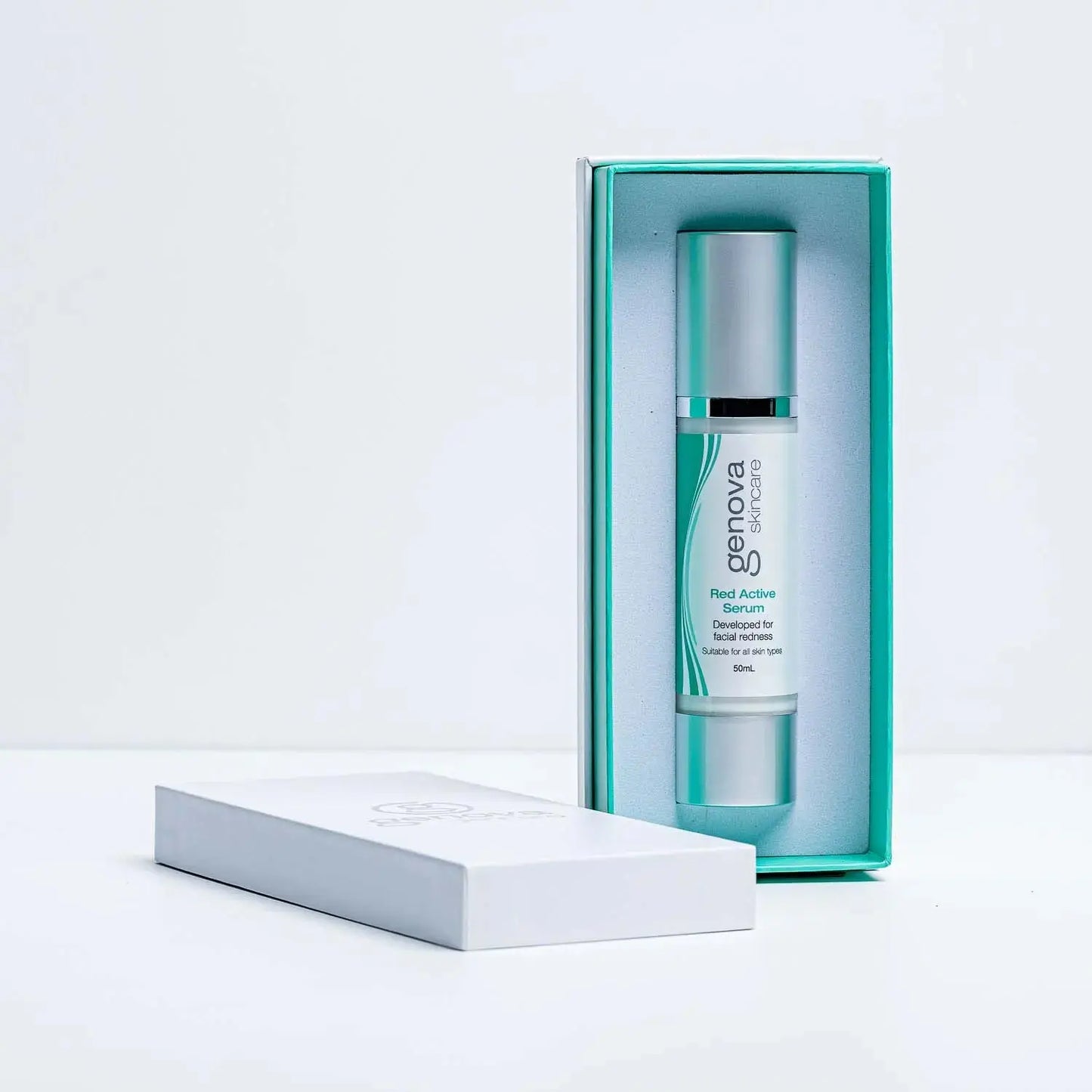
The serum step is where most of the calming work happens. Genova Red Active Serum is formulated for sensitive menopausal skin and visible surface reactivity.
The moisturiser rebuilds what each flush takes out. Genova Firming Cream uses Serilesine and Nocturshape peptides in a lipid-supporting base, made in Australia under strict quality-control standards. For longer-term peptide signalling, Genova Anti-Wrinkle Serum may help maintain support that estrogen used to provide.
Realistic expectations. A calming routine may help skin look less reactive within two to three weeks, with baseline cheek redness easing by week six to eight. Results vary. Skincare cannot stop hot flushes, cannot replace lost estrogen, and cannot remove vessels that have become persistently visible. It can change how much of each flush stays on your face afterwards.
How to Protect Menopausal Skin During Night Sweats
Three practical changes may take some load off the face overnight. Switch to a silk or smooth cotton pillowcase, which lifts damp away and reduces overnight friction. Keep a soft flannel and cool water by the bed for a quick press on the chest and neck mid-flush.
Apply moisturiser before bed, not after a 3am flush. A lipid-rich layer leaves the barrier with more reserve for a sweat event later. For women whose barrier is already in a reactive flare, our 14-day sensitivity reset is the first step, and the wider Menopause Skin Reset pathway covers the 12-week version.
Strengths of a calming routine for hot-flush-prone menopausal skin
- Targets the cumulative damage between flushes, where most visible change happens
- Peptides selected for reactive surface skin, not generic hydration
- Works alongside HRT or independently
- Australian-made under strict quality-control standards
Limitations of skincare for hot-flush-prone skin
- Cannot stop flushes from happening or shorten them
- Cannot remove vessels that have become persistently visible
- Cannot replace HRT for women whose flushes significantly affect sleep
- Six to eight weeks of consistent use is needed before the baseline shifts
A Daily Routine for Hot-Flush-Prone Menopausal Skin: Step by Step
Morning
- Splash with cool water, or cleanse with Active Foaming Cleanser if you slept through night sweats
- Apply Red Active Serum to cheeks, jawline and any area that flushes most
- Apply Firming Cream while skin is still slightly damp
- Finish with mineral SPF 30 or higher
Evening
- Cleanse with Active Foaming Cleanser to remove SPF, sweat and city particulates
- Apply Red Active Serum if your skin flushed during the day
- Apply Anti-Wrinkle Serum for longer-term peptide support
- Finish with a generous layer of Firming Cream before bed, not after a 3am flush
Who This Routine May Suit for Hot-Flush-Prone Menopausal Skin
It may suit you if:
- You experience daytime hot flushes that leave cheeks reactive afterwards
- You wake to a damp pillowcase and notice one cheek redder than the other
- Your baseline cheek redness has crept up over the last year or two
- You are using HRT and want a skincare layer that works alongside it
It may not suit you if:
- Your redness fits a diagnosed rosacea pattern already managed by your GP
- Hot flushes are significantly disturbing sleep and HRT has not yet been discussed
- You have broken or oozing skin that needs doctor-led assessment first
- You are looking for a product that stops flushes. Skincare cannot do that
Frequently Asked Questions About Hot Flushes and Menopausal Skin
Can skincare stop hot flushes from happening?
No. Hot flushes are a vasomotor event driven by the body's temperature regulation, not by the skin. Skincare changes how the skin recovers between flushes, but does not act on the flush trigger. If frequency is affecting your sleep, speak to your GP about HRT.
Why is one cheek redder than the other in the morning?
The pillowcase-side cheek often shows more redness after a night sweat. Sweat sits against that side of the face longer and the barrier reacts. A silk pillowcase and a lipid-rich evening cream may reduce the asymmetry.
Does a cool flannel during a flush help my skin?
Yes, to a small degree. A cool press shortens the time vessels stay fully dilated and reduces how much sweat sits on the face. Over time it lowers the surface load on the cheeks.
Will HRT improve my skin if it stops my flushes?
For many women, HRT reduces both flush frequency and skin reactivity, because falling estrogen drives both. This is a decision to make with your GP based on your full history. Skincare sits alongside HRT, not in place of it.
When should I see a GP about flushing that will not settle?
If your cheeks stay flushed between flushes, if redness spreads beyond the cheeks, or if you notice bumps or burning that does not ease with a gentler routine, see your GP. Rosacea and other doctor-led conditions can develop alongside menopause.
References
Lephart, E. D. (2018). A review of the role of estrogen in dermal aging and facial attractiveness in women. Maturitas, 109, 18-25.
Freedman, R. R. (2014). Menopausal hot flashes: mechanisms and endocrinology. Journal of Steroid Biochemistry and Molecular Biology, 142, 115-120.
Kendall, A. C., Pilkington, S. M., Wray, J. R., Newton, V. L., Griffiths, C. E. M., Bell, M., Watson, R. E. B., and Nicolaou, A. (2022). Menopause induces changes to the stratum corneum ceramide profile, which are prevented by hormone replacement therapy. Scientific Reports, 12(1), 21715.
Hot flushes are one of those parts of menopause that nobody quite prepares you for. The discomfort, the broken sleep, the quiet maths of which dress will hide the redness. Your skin sits inside all of that, taking small hits over and over. A calmer routine will not stop the flushes, but it can mean your face does not carry every one of them on the surface for hours afterwards. That is one less thing in the room with you.
This article is for educational purposes only and is not personalised advice. Genova products are cosmetic in nature and are designed to support the appearance of skin. Individual results vary. Please consult a qualified skin specialist or your GP for significant skin concerns including persistent flushing.