
Do Peptides Work On Menopausal Skin? The Science Explained
By Simon Mitchell
Quick Summary:
Peptides do work on menopausal skin, but more slowly than the marketing suggests. They are short chains of amino acids small enough to penetrate the skin barrier and signal cells to build collagen, calm inflammation or protect existing structure. The mechanism is well-documented in peer-reviewed peptide research. The catch: cellular response in mature skin is slower, so visible change takes 6 to 12 weeks rather than the 2 to 4 weeks marketing tends to imply.
This article refers to topical peptide skincare - serums, creams and eye products applied to the skin. It does not refer to injectable peptides, which are a different category and should only be discussed with qualified medical professionals.
You are standing at the chemist staring at three peptide serums that all promise the same things. Plumper skin. More firmness. Visible change in weeks. The bottles cost between $40 and $200 and the claims sound nearly identical. You have read enough skincare marketing in your fifties to know that promises do not equal results.
This skepticism is one of the most useful things you bring to menopausal skincare. You have lived through enough cycles to know what overselling sounds like. You are managing broken sleep, mood swings, a body that does not feel like yours. The last thing you have time for is another bottle that does nothing.
Peptides do work on menopausal skin, but not in the way the box usually describes them. The mechanism is real, the timeline is slower than marketing suggests, and the science is worth understanding before you spend money.
| Reader question | Honest answer |
|---|---|
| Do peptides work? | Yes, they may support visible firmness and texture over time |
| How long? | Usually 6–12 weeks |
| Are they instant? | No |
| Are they better than collagen cream? | Usually a stronger case than topical collagen |
| Can they replace menopause-related collagen loss? | No |
| Best use? | Twice daily with moisturiser and SPF |
Why You Should Be Skeptical Of Peptide Skincare Claims For Menopausal Skin
The peptide skincare market grew faster than the language around it. Brands use peptide names that sound impressive without explaining what they do, concentration is rarely listed, and "validated" claims often refer to studies on cells in a dish rather than on women over 45.
The visible evidence is also slow. Mature skin has a 50 to 60 day cell turnover cycle, so change happens underneath for weeks before it shows in the mirror. A product that works often looks like a product that does not, for the first month or two.
Worth being skeptical of: claims of "instant" firming, before-and-after photos in different lighting, "validated" claims without naming the study, and single peptide products priced like a full routine. Worth taking seriously: named peptides with described mechanisms, realistic 6 to 12 week timelines, clear acknowledgement of what the product cannot do, and independent research citations.
What Peptides Actually Are And How They Work On Menopausal Skin
Peptides are short chains of amino acids, the building blocks of proteins. Proteins build collagen, elastin and other structural elements. A peptide is shorter than a protein, usually between 2 and 50 amino acids long.
The key fact: peptides are small enough to penetrate the skin barrier. Most proteins, including collagen itself, are too large. A study by Bos and Meinardi in Experimental Dermatology established the 500 dalton rule: molecules under 500 daltons can penetrate the barrier and those above usually cannot. Most peptides sit within this range. Collagen molecules are vastly larger, which is why collagen creams cannot deliver collagen to where it is needed.
Once peptides penetrate, they act as messengers. Research in Frontiers in Pharmacology by Errante describes how peptide signalling works in mature skin: the peptide reaches the cell, binds to a receptor, and triggers a cellular response. For signal peptides, the response is "produce more collagen." For other peptide types, the response is different.
Menopausal skin is responsive to these signals but slower to act on them. Research in Maturitas by Lephart describes how estrogen receptors in skin cells help drive collagen production, and how cellular activity slows when estrogen declines. The signal arrives. The response builds at a slower pace.
Comparing The Main Types Of Peptides Used In Menopausal Skincare
Signal peptides
Examples include Matrixyl and palmitoyl pentapeptide-4. They tell fibroblasts to produce more collagen and elastin. Best for firmness, fine lines and structural support. Visible change in 6 to 12 weeks of twice-daily use.
Carrier peptides
Examples include copper peptides such as GHK-Cu. They transport trace minerals that support enzymatic processes in the skin. Best for barrier repair and wound-recovery-style processes. Effects build over weeks to months.
Neurotransmitter-inhibiting peptides
Examples include Argireline and Snap-8. They temporarily soften the muscle contractions that create expression lines. Best for forehead lines and crow's feet. Effects build over 4 to 8 weeks of continued use.
Enzyme-inhibiting peptides
Examples include Serilesine. They slow the enzymes that break down collagen and elastin. Best for protecting existing structural support. Protective rather than restorative, useful in menopausal skin where collagen loss is ongoing.
Most quality peptide skincare combines types rather than relying on a single peptide.
How Genova Peptide Skincare Works For Menopausal Skin Over 45
Genova products are formulated for Australian menopausal skin and made locally to strict quality-control standards. The peptide actives are named, the mechanisms are described, and the formulations combine peptide types to give the skin multiple signals at once.
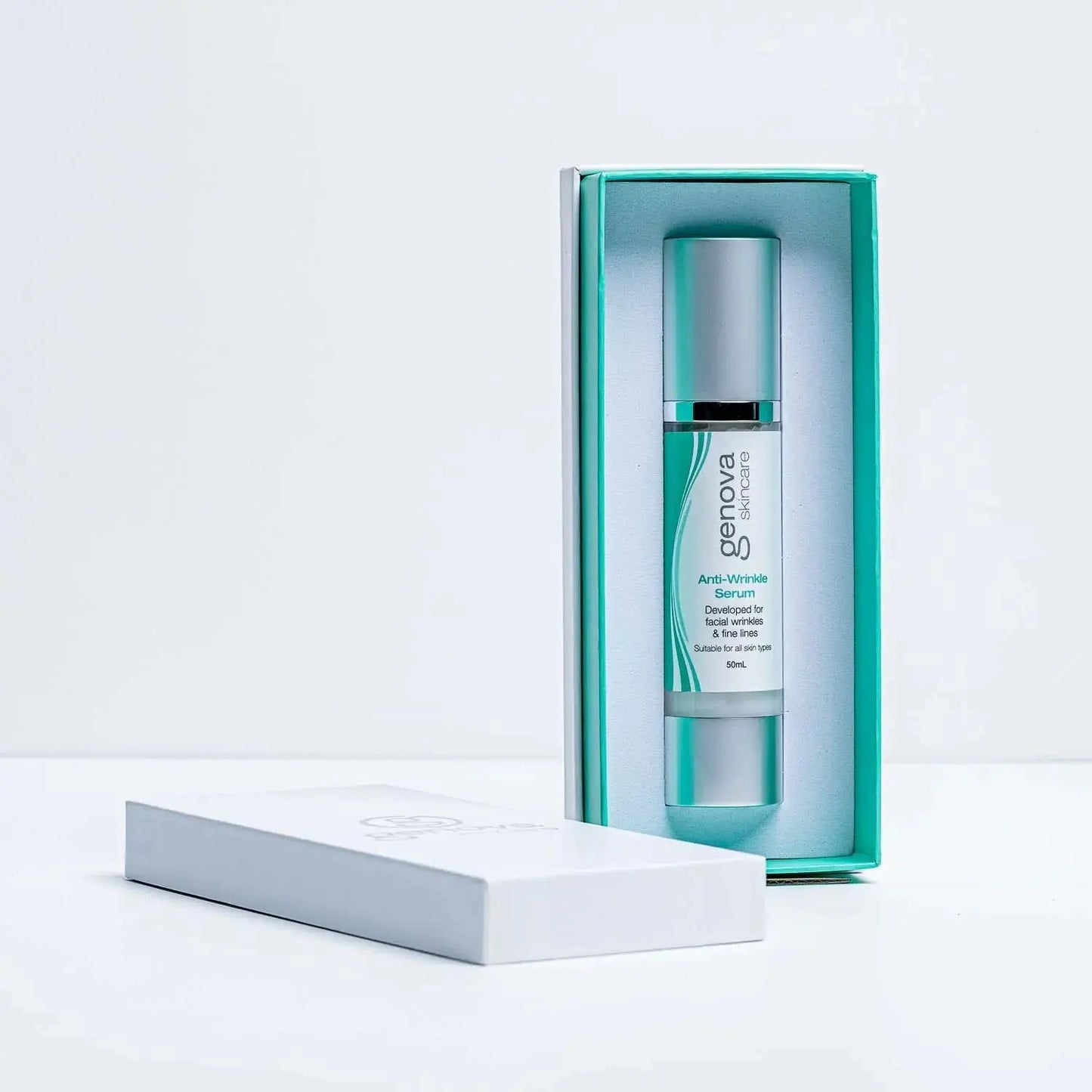
The Genova Firming Cream contains Serilesine (enzyme-inhibiting, slows collagen breakdown) and Nocturshape, applied twice daily to face and body. The Genova Anti-Wrinkle Serum uses Matrixyl-family signal peptides to support new collagen production. The Genova Perfecting Eye Serum combines Eyeseryl (anti-puffiness), Eyedeline (for dark circles) and Snap-8 (neurotransmitter-inhibiting) for the thinner skin around the eyes.
The combination gives the skin several signals at once: build new collagen, protect existing collagen, calm muscle activity. These are the same peptides described in the peer-reviewed research above.
Realistic Expectations: Peptides may help improve the appearance of firmness, texture and tone in menopausal skin over 6 to 12 weeks of twice-daily use. They cannot replace lost facial fat, lift loose hanging skin, work overnight, or produce the visible change that surgical or in-clinic procedures can. The full menopausal skincare timeline is mapped in the pillar post. Individual results vary based on age, baseline condition, sun exposure history and consistency of use.
Strengths And Limitations Of Peptides For Menopausal Skin
Strengths of peptide skincare for menopausal skin
- Penetrate the skin barrier where collagen molecules cannot
- Signal multiple pathways depending on peptide type
- Lower irritation profile than retinol or strong acids, suits sensitive menopausal skin
- Combine well with other actives in a layered routine
- Backed by mechanism research in peer-reviewed literature
Limitations of peptide skincare for menopausal skin
- Slower visible change than the marketing usually suggests
- Cannot replace estrogen or reverse hormonal collagen loss
- Cannot lift hanging skin or restore facial fat volume
- Quality varies enormously between brands and formulations
- Results depend on consistency and supporting habits (SPF, sleep, sun exposure history)
How To Tell If A Peptide Product Is Worth Trying After 45
- The peptides are named, not hidden behind generic "peptide complex" language.
- The mechanism is described in plain language, not marketing slogans.
- The expected timeline is stated clearly, usually 6 to 12 weeks for visible firmness change.
- The brand acknowledges what the product cannot do.
- The formulation is designed for the skin stage you are in (mature, menopausal, sensitive).
- There is independent research backing the peptide type, not just brand-funded studies.
- The price reflects what is in the formula, not the marketing budget.
If a product passes most of these checks, it is worth giving a fair 12 weeks of consistent use. If you are not seeing change at week 4, the five common mistakes post covers what is most often slowing results.
Who Peptide Skincare Suits And Who It May Not Suit After 45
It may suit you if:
- You are in perimenopause or post-menopause and want a low-irritation routine
- You prefer a science-backed signal approach to stronger active exfoliation
- You are willing to commit to 6 to 12 weeks before judging results
- You want a daily routine that builds slowly rather than a one-off intervention
It may not suit you if:
- You expect dramatic change in 2 to 4 weeks
- You want structural lifting that only in-clinic options can deliver
- You have a skin condition that needs a doctor-led plan
- You will not use the products twice daily for several weeks
Frequently Asked Questions About Peptides For Menopausal Skin
Are peptides better than retinol for menopausal skin?
Neither is universally better. Peptides have a lower irritation profile and suit sensitive menopausal skin. Retinol has more research behind it for collagen stimulation. Many women combine the two or alternate them. The retinol vs peptides post compares the two in depth.
Do peptides replace collagen lost during menopause?
No. Peptides signal the skin to produce more collagen, but they do not replace what has been lost. The body's collagen production slows after menopause, and even with peptide support it does not return to pre-menopausal levels.
Can I use multiple peptide products together?
Yes. Different peptide types address different concerns and work well together. A peptide serum, a peptide firming cream and a peptide eye serum can be used in the same routine without conflict.
How do I know if a peptide product is actually working?
Take a photo at day one, week 6 and week 12. Hydration and texture changes appear first, firmness later. If your skin feels calmer and holds water better by week 6, the routine is working underneath.
Are peptides safe to use long-term?
Yes. Peptides have a low irritation profile and no known cumulative risk with daily use. Most women continue a peptide routine indefinitely because the signal needs to be ongoing.
Why are some peptide serums so much more expensive than others?
Price reflects formulation cost, peptide concentration, supporting actives and brand margin. A higher price does not always mean better results. Named peptides matter more than the price tag.
References
Bos, J. D., & Meinardi, M. M. (2000). The 500 Dalton rule for the skin penetration of chemical compounds and drugs. Experimental Dermatology, 9(3), 165-169.
Lephart, E. D. (2018). A review of the role of estrogen in dermal aging and facial attractiveness in women. Maturitas, 117, 1-10.
Errante, F., Ledwoń, P., Latajka, R., Rovero, P., & Papini, A. M. (2020). Cosmeceutical peptides in the framework of sustainable wellness economy. Frontiers in Chemistry, 8, 572923.
Skepticism is the right starting point. Peptide skincare works, but slowly, and only on the parts peptides are designed to address. The marketing is louder than the science usually warrants, and the best products describe their limitations as clearly as their benefits. If you are starting fresh, the Firming Cream twice daily with the Anti-Wrinkle Serum underneath is the standard pairing. Give the signal time, and let your skin do the slower work it is built to do.
Disclaimer: This article is for general information only and is not a substitute for personal professional advice. Results vary between individuals and depend on age, skin condition and consistency of use. If you have specific skin concerns or conditions, please consult a qualified skin specialist or your doctor.