
Why Familiar Products Suddenly Sting in Perimenopause: A 14-Day Reset for Sensitive Skin After 45
By Simon MitchellQuick Summary:
Many women in perimenopause find that the moisturiser, cleanser or serum they have used for years suddenly stings, burns or causes redness. The cause is usually a weakened skin barrier driven by declining estrogen levels, reduced ceramide production, and slower repair. A 14-day reset using a gentle cleanser, a calming barrier-supportive serum, a simple moisturiser and daily SPF can settle most reactive perimenopausal skin. Persistent rashes or stinging that does not improve should be reviewed by a GP.
You unscrew the lid of the moisturiser you have used for ten years. You tap a small amount onto clean skin and within seconds your cheeks tingle, then burn, then redden in patches. You check the use-by date. You check whether you used the wrong cleanser. You did not. The product is the same. You are the one who has changed.
Of all the changes that arrive in perimenopause, this one is the most disorienting. The face you washed the same way for a decade now reacts to almost everything. Sleep is broken. Mood swings. Energy drops. And on top of that, your skin starts behaving like a stranger.
You are not imagining it, you are not doing anything wrong, and there is a clear reason for what you are feeling.
What Sudden Skin Sensitivity Looks Like in Perimenopause
Most women describe it the same way. A tingle within seconds of applying a familiar product. Sharp warmth across the cheeks or forehead. Patches of redness that take an hour to settle. A tight, itchy feeling after cleansing. Skin that flushes after a glass of wine when it never used to.
The pattern is often unpredictable. A product that stings one week may feel fine the next. New ingredients you used to tolerate now flare your skin. Even water can feel harsh.
This is reactive skin, sometimes called sensitised skin. It is a temporary state caused by a weakened skin barrier, and in perimenopause, the barrier is under more pressure than at any other point in adult life.
Why Your Skin Reacts to Familiar Products in Perimenopause
Your skin barrier is a wall of cells held together by a mix of fats called lipids. Ceramides are one of the most important lipids. They keep water in and irritants out. Estrogen helps the skin produce them.
Research published in Scientific Reports (Kendall 2022) found that post-menopausal skin has lower ceramide levels and shorter ceramide chain lengths than pre-menopausal skin. Women on hormone therapy did not show the same pattern, which suggests estrogen plays a direct role in how the skin barrier is built.
A review in Maturitas (Lephart 2018) explains that as estrogen declines, oil production drops, water loss increases and the skin becomes more reactive to products and the environment. The barrier becomes thinner. Small irritants get through more easily. Nerve endings sit closer to the surface. A familiar product now reaches places it never used to.
Add the fact that perimenopausal skin is often drier, slower to repair and more inflamed in general, and the result is the moment at the bathroom mirror you keep having. The product did not change. Your skin's tolerance did.
How Different Approaches Compare for Reactive Perimenopausal Skin
There is no single fix. Most women settle reactive skin with a combination of pause, simplify and rebuild.
Click to expand
Pause and patch test (simplify the routine)
Stop everything except a gentle cleanser, a basic moisturiser and SPF for 7 to 14 days. Reintroduce one product at a time, leaving 3 to 4 days between each. This identifies the trigger and lets the barrier settle. Best first step for most women.
Switch to barrier-focused cleansers and moisturisers
Replace foaming, fragranced or exfoliating cleansers with a gentle non-stripping option. Choose moisturisers with ceramides, glycerin, squalane or panthenol. Realistic timeframe: skin often feels calmer within 2 weeks.
Add a calming barrier-supportive serum
Ingredients such as niacinamide, centella asiatica and panthenol may help reduce redness and support barrier repair. A simple calming serum slotted between cleanser and moisturiser can speed up recovery for reactive perimenopausal skin.
Professional review
If stinging continues for more than 4 weeks despite a simplified routine, or if there is rash, swelling or weeping, ask your GP for a referral. Some perimenopausal flare-ups overlap with eczema, rosacea or contact reactions and may need a tailored approach.
How Genova Skincare May Help Sensitive Perimenopausal Skin
Genova is an Australian-made skincare range formulated for women in perimenopause and menopause. The Genova approach to reactive skin is not a single hero product. It is a small, calm routine designed to settle the barrier first and add actives back later.
The Active Foaming Cleanser is designed to remove oil and product residue without stripping the skin barrier. It suits reactive perimenopausal skin that no longer tolerates harsh foaming or fragranced cleansers.
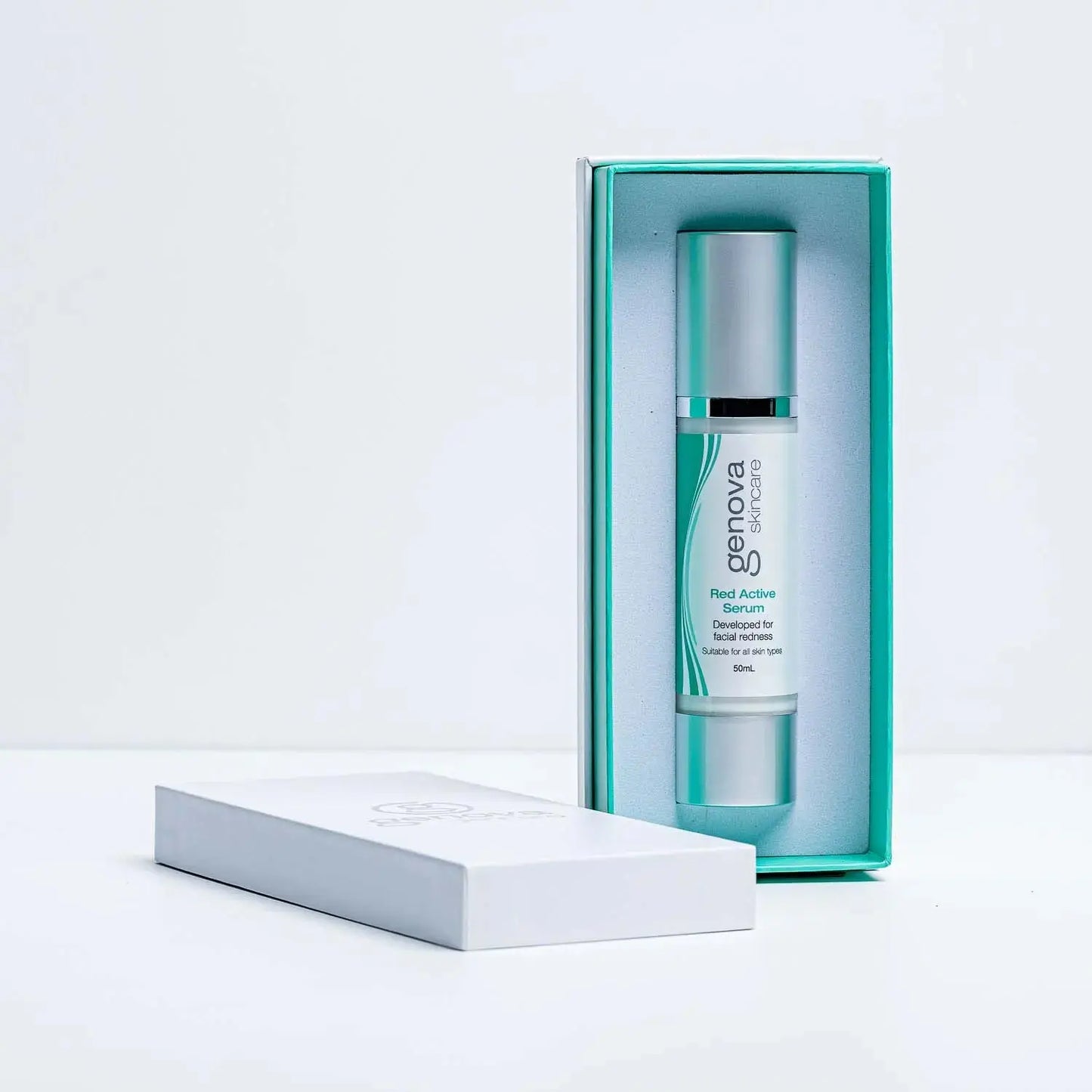
The Red Active Serum is formulated for sensitive menopausal skin and may help calm visible redness while supporting the barrier. It pairs well with a simple ceramide-rich moisturiser as part of a 14-day reset.
For the underlying biology, see our guide to the menopausal skin barrier and how to repair it.
Realistic Expectations: A 14-day reset will not rebuild the skin barrier completely, and it will not stop perimenopausal hormonal change. What it can do is reduce active stinging, redness and tightness, and give you a working baseline routine. Most women feel less reactive by day 7, and look calmer by day 14. Full barrier recovery takes 6 to 12 weeks of consistent use. Results vary with sleep, stress, alcohol and overall skin health.
Strengths and Limitations for Reactive Perimenopausal Skin
Click to expand
Strengths
- Gentle enough for skin that has become reactive in perimenopause
- Skin-compatibility tested for sensitive mature skin
- Australian made and formulated for the Australian climate
- Pairs cleanly with the rest of the Genova range as the skin settles
- No fragranced foaming cleansers, no harsh exfoliating acids
Limitations
- Will not stop the hormonal changes that drive perimenopausal sensitivity
- Reactive skin still needs a slow reintroduction of any active ingredients
- Visible calm usually appears in 2 weeks, full recovery takes longer
- Results vary with broken sleep, alcohol intake and stress levels
- Not a substitute for review by a GP if stinging persists or a rash appears
How to Run a 14-Day Reset for Sensitive Menopausal Skin
- Day 1 to 3: Stop all serums, retinol, exfoliants and masks. Cleanse once a day with the Active Foaming Cleanser, rinse with cool water, follow with a simple ceramide moisturiser and SPF 50+ each morning.
- Day 4 to 7: Add a thin layer of the Red Active Serum after cleansing in the morning. Continue cool rinses. Avoid hot showers on the face.
- Day 8 to 10: Add an evening cleanse if needed. Keep the routine to cleanser, serum and moisturiser only.
- Day 11 to 14: Note which areas still flush or sting. If skin feels calmer, you can reintroduce one extra product (such as a peptide serum or a low-strength acid) every 4 days.
- Throughout: Daily broad-spectrum SPF 50+ every morning, even on cloudy Australian days. Sun exposure is one of the strongest perimenopausal flare triggers.
Who This Reset Suits in Perimenopause
It may suit you if:
- You are 45 to 65, and your familiar skincare has started to sting or burn
- You see patches of redness, tightness or itch after applying products
- You want a calm, gentle routine you can stay on for several weeks
- You prefer to settle the barrier before adding back stronger actives
It may not suit you if:
- You have a rash, weeping skin, swelling or pain that needs review by a GP
- You are pregnant, breastfeeding or managing a known skin condition without input from your doctor
- You are sensitive to any of the listed ingredients
- You expect an overnight resolution of long-standing reactive skin
FAQ About Sensitive Skin in Perimenopause
Why does my moisturiser suddenly sting in perimenopause?
Falling estrogen lowers ceramide production and weakens the skin barrier, so familiar products reach deeper layers and irritate nerve endings that were previously protected. The product has not changed; the skin's tolerance has.
Is sensitive skin in perimenopause permanent?
For most women, it is a temporary state caused by a weakened barrier, not a permanent skin type. With a calm 14-day reset and a barrier-focused routine, sensitivity usually settles, though hormonal flare-ups can recur.
How long does a perimenopause skin reset take to work?
Most women feel less stinging by day 7 and look calmer by day 14. Full barrier recovery takes 6 to 12 weeks of consistent use. Sleep, alcohol and stress all influence the timeline.
Can I still use retinol if my skin is sensitive in perimenopause?
Pause retinol during the 14-day reset, then reintroduce it slowly twice a week if your skin is calm. Many perimenopausal women find peptides or bakuchiol gentler alternatives during reactive phases.
Should I see a doctor about sensitive skin in perimenopause?
Yes, if you have a rash, weeping, swelling, blistering or stinging that does not improve with a simplified routine after 4 weeks. Some flare-ups overlap with eczema, rosacea or contact reactions that need a tailored approach.
References
- Kendall AC, et al. Menopause induces changes to the stratum corneum ceramide profile, which are prevented by hormone replacement therapy. Scientific Reports, 2022.
- Lephart ED. A review of the role of estrogen in dermal aging and skin function. Maturitas, 2018.
If your face has been quietly turning on you, it helps to know there is a reason and a way through. The same skin that suddenly stings can settle. A small, gentle routine for 14 days, then a slower reintroduction of the products you love, often makes a noticeable difference. You have enough on your plate in perimenopause without the bathroom shelf feeling like a minefield. One calm step at a time is plenty.
This article is for general information only and does not constitute personal advice. Genova products are cosmetics, not medicines. Results vary between individuals. If you have a rash, persistent stinging or swelling, please consult your GP.