
Menopausal Acne in Perimenopause and Menopause: Causes and Treatments That May Help
By Simon MitchellMenopausal acne affects roughly one in four women in their 40s and around 15% of women in their 50s. The main cause is a shift in hormone balance, with falling estrogen levels leading to relative androgen dominance that increases oil production. Menopausal breakouts typically appear along the jawline and chin, not the forehead, and respond differently to treatment than teenage acne. Gentle, non-stripping skincare that targets sebum at the source tends to work better for this skin type. Consistent topical treatment generally takes 8 to 12 weeks to show measurable improvement.
Why Menopausal Acne Feels Like One More Thing to Deal With
Menopause brings a lot at once. Sleep is disrupted by night sweats. Energy that does not come back the way it used to. A body and mood that can shift in ways that feel unpredictable, sometimes within the same day. The skin changes too, but in ways that are rarely talked about honestly.
For many women, the surprise is not the dryness or the fine lines. It is the breakouts. Persistent, sore spots along the jaw and chin appeared at an age when acne was supposed to be a distant memory. That particular combination, feeling too old for pimples and too young for what is actually happening, carries a quiet frustration that can be hard to put into words.
You are not imagining it. Research published in the Journal of Clinical and Aesthetic Dermatology suggests that around 26% of women in their 40s and 15% of women in their 50s experience acne during perimenopause or menopause. It is a real, physiological response to hormonal change, and it is far more common than most skincare conversations acknowledge.
The skin is one burden you may be able to ease. Understanding why this happens is where that starts.
What Causes Hormonal Acne During Perimenopause and Menopause
The core issue is a change in hormone balance. As estrogen levels decline during perimenopause, androgen levels, including testosterone, remain relatively stable. Research published in the American Journal of Clinical Dermatology describes this as relative androgen dominance, in which androgens have a greater influence on the skin than when estrogen is higher.
Androgens stimulate the sebaceous glands to produce more oil. More oil means a higher chance of pores becoming blocked, bacteria multiplying, and inflammation developing. At the same time, declining estrogen slows skin cell turnover, so dead cells are not shed as efficiently. The combination can be a reliable trigger for breakouts.
Menopausal acne looks and behaves differently from teenage acne. Rather than appearing across the forehead and nose, it typically clusters along the lower face, the jawline, chin, and sometimes the neck. Spots are often deeper, more inflammatory, and slower to resolve than the surface breakouts of adolescence.
Why Teenage Acne Products Often Make Perimenopausal Skin Worse
This is a trap many women fall into, reaching for products that worked at 17 and finding their skin reacts badly. Products designed for teenage acne are typically built around high concentrations of benzoyl peroxide and harsh surfactants. They are formulated for oilier, more resilient skin that tolerates aggressive ingredients.
Perimenopausal and menopausal skin is different. It is often simultaneously oily in some areas and dry or sensitive in others, with a weaker barrier than it had two decades ago. Aggressive acne treatments can strip existing moisture, further compromise the barrier, and even worsen inflammation. The result is skin that feels reactive and tight and still breaks out.
This skin type responds better to targeted treatments that regulate sebum production without destabilising the barrier or triggering further dryness. Ingredients worth looking for include salicylic acid at lower concentrations (which clears pore congestion without over-drying), peptide-based actives that support the skin's natural defences, and marine-derived ingredients that reduce sebum production at the sebaceous gland level rather than just treating surface oil.
What to Look for in a Blemish Treatment for Menopausal Skin
Not all blemish treatments are formulated with menopausal skin in mind. The key difference is whether the product accounts for barrier sensitivity and dryness alongside congestion control. Many do not.
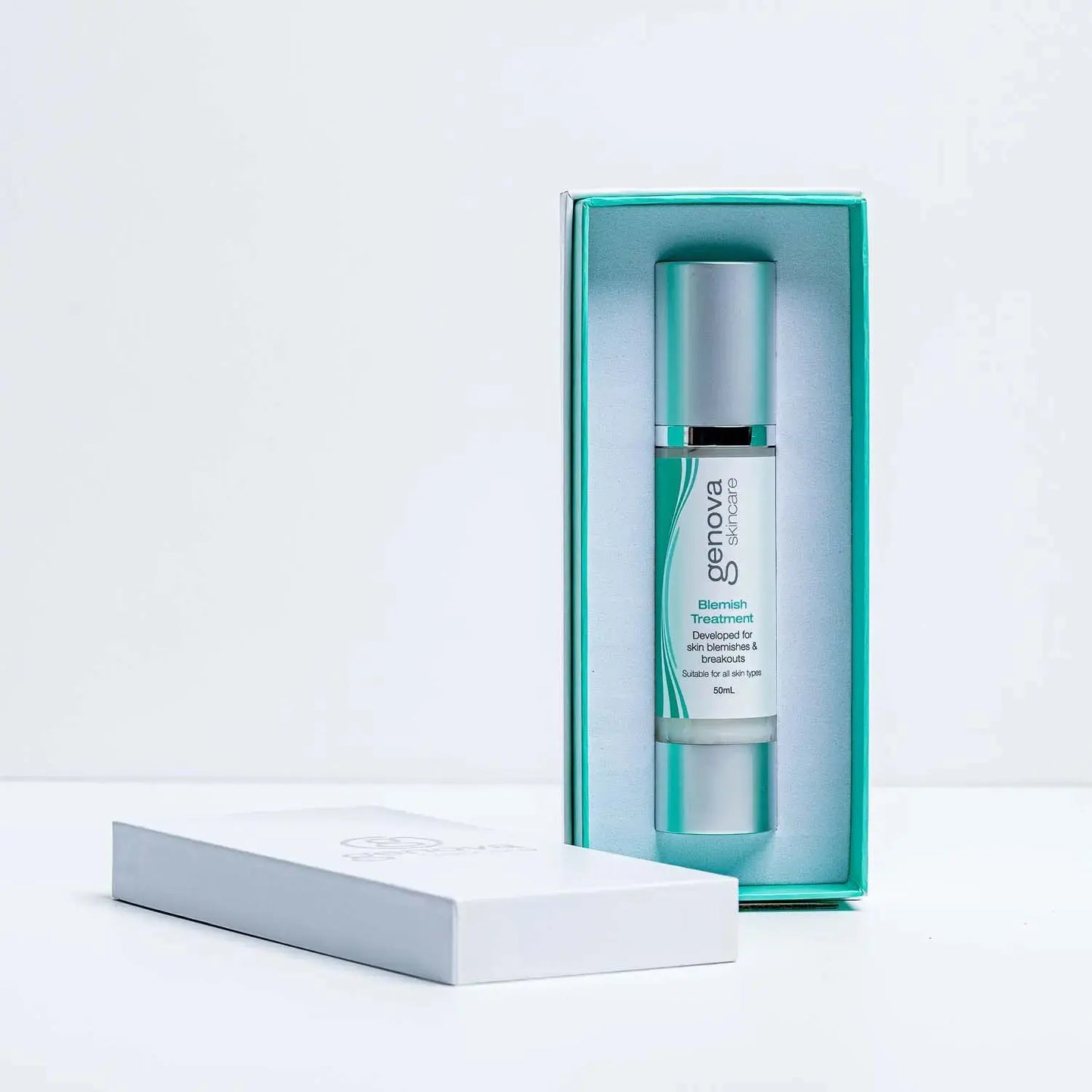
Genova Blemish Treatment is one option worth considering for women in this stage of life. It was developed specifically for hormonal skin changes rather than teenage skin, and the formulation reflects that. For targeted spot treatment on individual blemishes, the Genova Blemish Spot Gel can be used alongside it as a direct application to active breakouts.
The active ingredients work across several aspects of menopausal breakouts. Salicylic acid penetrates pores and helps clear the debris that leads to congestion. Bodyfensine, a peptide, supports the skin's own antimicrobial defences and may help reduce the inflammation and redness associated with active spots. Matmarine, a marine-derived biotechnology, works directly on the sebaceous glands to reduce sebum production, addressing one of the root causes of hormonal breakouts rather than just the symptoms. Peelmoist supports hydration throughout, which helps prevent the dryness that can make barrier compromise worse.
Because it is benzoyl peroxide-free, it is less likely to cause the reactive dryness and sensitivity that many women over 45 experience with standard acne products. It is not a medical treatment for severe or cystic acne, and individual results vary. But for mild to moderate hormonal breakouts, it may be a more appropriate starting point than products designed for a different skin type.
Realistic Expectations for Menopausal Acne Skincare
Hormonal acne is one of the more challenging skin concerns to manage because the underlying cause is internal. Topical skincare can meaningfully reduce breakouts, calm inflammation, and help prevent new spots forming. What it cannot do is resolve the hormonal shift driving the process.
Most women see improvement over 8 to 12 weeks of consistent use. Some respond faster. Others find that breakouts return during particularly intense hormonal fluctuations regardless of their routine, and that is not a failure of the product or the routine. It is the nature of hormonally driven skin. The realistic goal is meaningful reduction and better day-to-day management, not permanent clearance from topical care alone.
Pros and Cons of Topical Blemish Treatment for Menopausal Skin
May work well if: Your breakouts are mild to moderate. You want a non-prescription starting point. You have found standard acne products too harsh or drying. You are looking for something you can add to your existing routine without a complete overhaul.
Limitations to know: Topical treatments alone are unlikely to resolve severe or cystic acne. They will not address the underlying hormonal cause. Results take 8 to 12 weeks, not days. Individual skin response varies significantly.
Who It's For, and Who Should Speak to a GP First
Likely suitable for
Women in perimenopause or post-menopause experiencing mild to moderate breakouts, particularly along the jawline or chin. Women who have found conventional acne products too harsh, drying, or reactive on mature skin. Those who want a non-prescription option to trial before seeking medical input.
Speak to a GP or dermatologist first if
Your acne is severe, cystic, or causing significant scarring. Breakouts are accompanied by other signs of hormonal imbalance such as unexpected hair loss or excess facial hair. Topical treatments have not improved things after 12 weeks of consistent use. Acne has appeared suddenly and you have never experienced it before, it is worth ruling out other causes.
Common Myths About Menopausal Acne That Can Make It Worse
Myth: Menopausal acne is just teenage acne returning
Reality: It may look similar on the surface, but the hormonal context is entirely different. Teenage acne is driven by surging hormones. Menopausal acne is driven by declining estrogen creating a relative androgen dominance. The skin behaves differently, the breakout patterns differ, and the treatments that work differ too.
Myth: If your perimenopausal skin is breaking out, stronger products will clear it faster
Reality: On mature, hormonally compromised skin, harsher is rarely better. Aggressive acne products can strip the barrier, increase sensitivity, and worsen inflammation without meaningfully resolving hormonal breakouts. A gentler, targeted approach almost always performs better on skin in this stage of life.
Myth: Menopausal skin cannot be both oily and dry at the same time
Reality: This is one of the most confusing aspects of hormonal skin, and it is completely real. Declining estrogen weakens the skin barrier and reduces moisture retention, while androgen activity increases sebum production. The result is skin that feels tight and dry in some areas while still congesting and breaking out in others.
Myth: A topical product can fully fix hormonal acne in menopause
Reality: Topical skincare can meaningfully reduce breakout frequency and severity, calm visible inflammation, and support a clearer complexion day to day. What it cannot do is switch off the internal hormonal changes driving the process. Realistic expectations, and consistent use over 8 to 12 weeks, are what lead to the best outcomes.
How to Use a Blemish Treatment as Part of a Menopausal Skincare Routine
- Cleanse gently with a pH-balanced, non-stripping cleanser morning and evening.
- Apply blemish treatment to affected areas on clean, dry skin. Focus on the lower face, jawline, and chin, where hormonal breakouts tend to cluster.
- Follow with a moisturiser that supports barrier health. Look for ceramides or hyaluronic acid in the formula.
- Apply broad-spectrum SPF 30 or higher every morning. UV exposure darkens post-blemish marks and slows their fading.
- Avoid touching or picking at breakouts. This increases inflammation and raises the risk of scarring, which is harder to resolve on mature, hormonally thinning skin.
- Give the routine at least 8 weeks before evaluating results. Hormonal skin responds slowly, and early discontinuation is the most common reason treatments appear not to work.
Frequently Asked Questions About Menopausal Acne
Does menopausal acne go away on its own?
For many women, breakouts do reduce after the full menopause transition is complete and hormone levels stabilise. The timeline varies and can span several years. Managing the skin consistently during perimenopause may help reduce severity and frequency in the meantime.
Is menopausal acne the same as teenage acne?
No. Menopausal acne is driven by a relative androgen dominance as estrogen falls, rather than the hormone surges of puberty. It tends to appear lower on the face, along the jawline and chin, and the spots are often deeper and more inflammatory than teenage breakouts.
Will HRT help with menopausal acne?
Some women find that hormone replacement therapy improves their skin, including breakouts, by restoring estrogen balance. Others find no change or some initial worsening. This is worth discussing with your GP, as HRT affects the whole body, and the right approach depends on your individual health picture.
Can I use my old acne products during menopause?
Caution is sensible. Products built for teenage skin, particularly those with high concentrations of benzoyl peroxide, can be too harsh for mature, hormonally compromised skin. They may strip moisture, disrupt the barrier, and increase sensitivity without meaningfully resolving hormonal breakouts.
How long does menopausal acne last?
This varies considerably. Some women experience it only during perimenopause, while others find it continues into post-menopause. Duration and severity depend on individual hormone patterns, genetics, stress levels, and how the skin is supported during the transition.
Does diet affect menopausal acne?
Research suggests a possible link between high-glycaemic foods and acne across all ages. Dairy has also been associated with acne in some studies, though evidence is mixed. A balanced diet with anti-inflammatory foods may support clearer skin alongside targeted topical care, but diet alone is rarely enough to resolve hormonally driven breakouts.
What ingredients should I avoid with menopausal acne-prone skin?
Heavy oils and comedogenic ingredients can worsen congestion. High concentrations of benzoyl peroxide, fragrance, and alcohol-based products may irritate a barrier that is already compromised by hormonal change. Patch testing new products before full application is always sensible with sensitive, transitioning skin.
Menopausal acne is not a reflection of how well you are looking after yourself. It is a hormonal response, and it is happening to a lot of women who are managing far more than anyone sees. The skin changes are real, and so is the frustration. But this is also one of the areas where consistent, targeted care can genuinely make a difference. Small, steady improvements over weeks are still improvements. Your skin is not beyond help, it is just asking for a different kind of it now.
References:
- Journal of Clinical and Aesthetic Dermatology, Dréno B. et al. (2019). Menopausal acne: challenges and solutions.
- American Journal of Clinical Dermatology, Thornton M.J. (2001). Estrogen and skin: an overview.
Disclaimer: This content is for educational purposes only and does not constitute medical advice. Genova Blemish Treatment is a cosmetic product. Individual results vary. For severe, cystic, or persistent acne, or if you have concerns about underlying hormonal health, consult a GP or dermatologist.