
Avène vs Peptide Redness Serum: Which Is Better for Redness After 45?
By Simon MitchellQuick Summary:
Avene Antirougeurs and peptide-led redness serums approach facial redness differently. Avene centres on thermal spring water and surface-calming ingredients to soothe reactivity in the moment. Peptide-led serums may help support the barrier and calming pathways that influence how reactive the skin looks over time. For menopausal skin, where the redness pattern has shifted, the two can be complementary, and one usually fits better than the other. Results vary.
You are standing in front of the Avene display in the chemist's for the third year running. The bottle in your hand is the same one you used in your forties. The skin on your cheeks is not. It flares at 3pm in the office. It blotches after a glass of wine you used to handle. It looks fine for a week then suddenly does not. You have been loyal to a product range that helped you once and is not quite getting you back to settled now.
This is one of the quieter frustrations of perimenopause and beyond. The redness is not new, but the pattern has changed, and the cream that used to work has not changed with it. Before you reach for the same bottle again, it is worth knowing what each kind of redness product can and cannot do on skin that is operating with a different hormonal backdrop.
Why Menopausal Skin Flushes and Stays Red After 45
Falling estrogen affects skin in ways that go beyond dryness and firmness. Estrogen helps regulate blood vessel tone, skin barrier strength, and inflammatory response. Research published in Maturitas notes that the drop in estrogen at menopause is linked with more reactive skin, more visible redness, and a barrier that takes longer to recover from triggers.
A study in the British Journal of Dermatology by Gether and colleagues also found that rosacea prevalence rises sharply in women in their forties and fifties, which overlaps with the menopausal window. So if your skin is suddenly flushing, blotching, or sitting pink for longer than it used to, the trigger may not be your skincare habits. The skin is responding to a different chemistry.
The redness women see after 45 is rarely caused by one thing. It is usually a combination of a thinner barrier, more reactive blood vessels at the surface, and an inflammatory baseline that has shifted upward. That is why a single calming ingredient often takes the heat down without resolving the underlying pattern. Picking the right product means understanding which layer it actually works on.
What Avene Antirougeurs Actually Does for Sensitive Skin
Avene is built around thermal spring water from the Cévennes region of southern France, which has a low mineral content and a specific microflora the brand has studied for decades. The Antirougeurs range pairs that water with ingredients aimed at soothing reactivity, including hesperidin methyl chalcone, dextran sulfate, and various plant-derived calming actives.
Research summarised in the European Journal of Dermatology has examined the soothing effect of Avene thermal spring water on sensitive skin. The findings broadly support its use as a comfort and calming step in a sensitive skin routine. What the evidence does not strongly establish is structural change to the redness pattern itself. Avene is well suited to calming a reactive surface in the moment. It is less designed to shift the underlying drivers of menopausal redness.
How Peptide Redness Serums Work on Menopausal Skin
Peptide redness serums work on a different mechanism. The redness women see after 45 is often a combination of two things, a thinner barrier that lets triggers through more easily, and microcirculation that has become more reactive. A peptide-led serum aims to support both, with signal peptides that may help reinforce the barrier and calming actives layered alongside to dial down vessel reactivity.
This is the meaningful difference. Avene calms the surface so it can recover. A peptide serum is designed to help the skin become less reactive in the first place. Both have value. The right tool depends on whether your priority is in-the-moment comfort or a more gradual settling of the pattern. Our piece on inflammaging in menopausal skin goes deeper into the underlying mechanism behind persistent redness after 45.
Comparing Redness Approaches for Women Over 45
The redness category sits in a few different camps once you look past the marketing. Most products fall into one of four buckets, and they are not interchangeable.
Avene Antirougeurs and similar thermal water lines
Best for: in-the-moment calming, surface comfort, sensitive skin support, post-procedure or flare-day use. Realistic timeframe: comfort within minutes, no expected structural change to the redness pattern. Cost: mid. Limitation: works on the surface, not the underlying barrier or vessel reactivity.
Peptide redness serums
Best for: gradually settling the underlying pattern of menopausal redness, supporting barrier function over time. Realistic timeframe: visible settling from 6 to 12 weeks of consistent twice-daily use. Cost: mid to higher. Limitation: not designed for in-the-moment flare comfort, less immediate than thermal water.
Choose Avène if:
You want quick comfort, post-flush cooling, or a gentle support product for reactive days.
Choose a peptide redness serum if:
Your redness pattern has changed after 45 and you want a daily serum to support calmer-looking skin over 6–12 weeks.
Speak to a doctor if:
Redness is painful, persistent, hot, bumpy, worsening, or includes visible broken capillaries.
Azelaic acid serums and creams
Best for: redness with visible bumps, blotchy patterns, mild rosacea-like presentation. Realistic timeframe: 8 to 12 weeks. Cost: low to mid. Limitation: can sting on very sensitive skin, best introduced gradually and not paired with other strong actives.
Doctor-led options
Best for: confirmed rosacea, persistent redness that has not responded to topicals, visible broken capillaries. Includes topicals from your GP and in-clinic vascular laser. Realistic timeframe: variable. Cost: significantly higher. Limitation: requires a consultation with your GP or a qualified skin specialist for assessment.
Where Genova Red Active Serum Fits in a Mature Routine
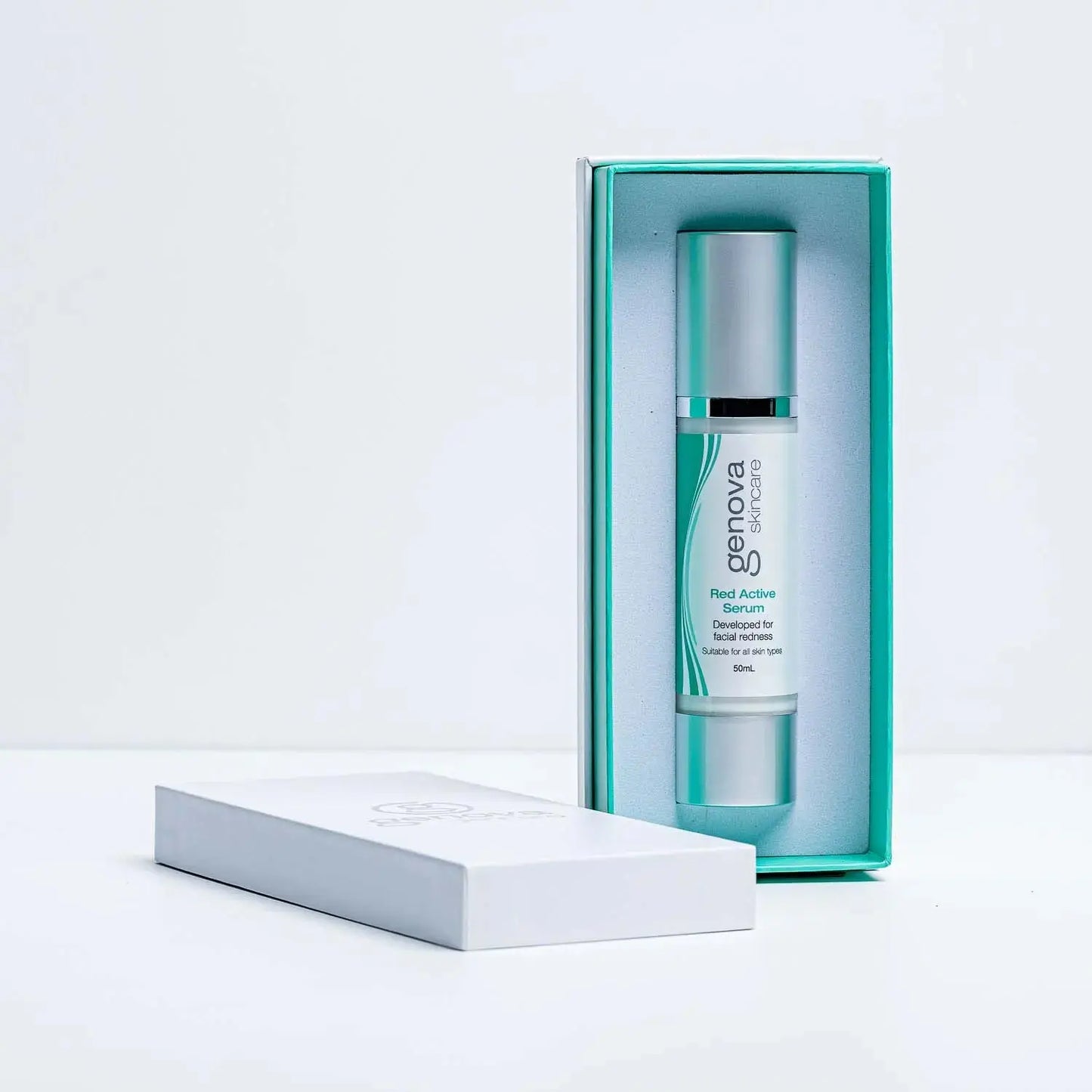
Genova Red Active Serum is one peptide-led option for women managing menopausal redness, sensitivity, or rosacea-prone skin. It is formulated specifically for thinner mature skin and pairs signal peptides with calming actives aimed at the barrier and surface vessel response. It is an Australian made formula produced under strict quality-control standards.
A typical menopausal-redness routine after 45 pairs Red Active Serum twice daily with a non-stripping cleanser such as Active Foaming Cleanser, and a barrier moisturiser on top. The serum is not designed to replace in-the-moment soothing on a hot flush day, where a thermal spring water spritz can sit alongside it without conflict. For more on building the routine end to end, our menopausal rosacea-prone skin routine walks through layering in detail.
Realistic expectations: Most women see surface comfort within 2 to 3 weeks and a gradual settling of the underlying redness pattern from 6 to 12 weeks of consistent twice-daily use. A peptide redness serum cannot replace lost estrogen, remove broken capillaries, or resolve confirmed rosacea on its own. It is one part of a calm routine. Confirmed rosacea is a conversation for your GP or a qualified skin specialist. Results vary.
How to Choose Between Avene and a Peptide Serum After 45
The simplest way to choose is to ask what you want the product to do. If your priority is comfort in the moment, on a flare day or after a procedure, a thermal water-based product such as Avene does that well and has decades of use behind it. If your priority is to settle the underlying pattern of menopausal redness over the next few months, the peptide-led serum has the stronger case.
The two are not mutually exclusive. Many women use a peptide serum as their twice-daily structural step and keep a thermal water spritz in the fridge for hot flush moments. What you do not need is two products doing the same job. For a calm staged introduction to a new routine, our menopause skin reset pathway covers a 12-week approach.
Strengths of a peptide redness serum for women after 45
- Designed to support barrier function rather than only soothe the surface
- Suits thinner perimenopausal skin and overlapping sensitivity
- Can sit under a barrier moisturiser without weighing the skin down
- One step covers the broader redness pattern across face and cheeks
- Australian made under strict quality-control standards
Limitations to know
- Not designed for immediate in-the-moment flare comfort
- Cannot remove broken capillaries or visible vessels, which are a vascular laser conversation
- Will not resolve confirmed rosacea on its own
- Needs 6 to 12 weeks of consistent twice-daily use before judging
- Strong actives such as retinol or high-strength acids may need to be paused while you settle the redness
How to Use a Peptide Redness Serum After 45
- Cleanse with a gentle non-stripping cleanser, morning and night.
- Pat skin almost dry. Apply 3 to 4 drops of peptide redness serum across cheeks, nose, chin, and forehead.
- Allow 60 seconds to settle before your next step.
- Layer a barrier moisturiser on top to lock the serum in.
- In the morning, finish with SPF 50. Sun exposure is one of the most common redness triggers in menopausal skin.
- Continue twice daily for at least 6 to 12 weeks before judging. On hot flush days, a thermal water spritz can sit alongside without conflict.
Who a Peptide Redness Serum May Suit and Who It May Not for Mature Skin
It may suit you if:
- You are in perimenopause or beyond and your redness pattern has shifted
- You have used thermal water products and feel they comfort but do not settle the pattern
- Your cheeks flush easily, blotch after triggers, or sit pink for longer than they used to
- You want one structural step rather than several layered redness products
It may not suit you if:
- Your main concern is visible broken capillaries, a vascular laser conversation
- You have a confirmed rosacea diagnosis that is not yet settled with a doctor's plan
- You want an in-the-moment flare product rather than a daily routine step
- You have known peptide ingredient sensitivity, patch test first
Frequently Asked Questions About Avene and Peptide Serums for Menopausal Redness
Can I use Avene and a peptide redness serum together?
Yes. Many women use a peptide serum as their twice-daily structural step and keep a thermal water spritz for hot flush moments. Apply the peptide serum first to clean skin, then layer the thermal water or barrier moisturiser on top.
How long does a peptide redness serum take to work after 45?
Most women see surface comfort within 2 to 3 weeks and a gradual settling of the redness pattern from 6 to 12 weeks of consistent twice-daily use. Mature skin sometimes needs the longer end of that window.
Will a peptide serum remove broken capillaries?
No. Visible broken capillaries sit in the vascular layer and require an in-clinic conversation, typically a vascular laser session with a qualified skin specialist. A peptide serum may help the surrounding skin look calmer, which softens the overall look.
Is Avene thermal spring water actually doing anything?
Research suggests it has a calming effect on sensitive skin in the moment. It is not designed to change the underlying redness pattern. As a comfort step, it has a long use record and is generally well tolerated.
Can I use retinol or vitamin C with a peptide redness serum?
Most peptide redness serums sit well with vitamin C in the morning. Retinol is more variable, and if your skin is currently flaring it is usually better to pause retinol while the redness settles. Our piece on ceramides for menopausal skin covers barrier-friendly layering in more detail.
Should I see a doctor about my redness?
Yes if your redness is persistent, painful, comes with bumps, or has not settled with topicals. Confirmed rosacea is a doctor-led conversation, and the right plan may include topicals from your GP as well as a daily routine step.
References
- Gether L, Overgaard LK, Egeberg A, Thyssen JP. Incidence and prevalence of rosacea: a systematic review and meta-analysis. British Journal of Dermatology. 2018;179(2):282-289.
- Lephart ED. Skin aging and oxidative stress: Equol's anti-aging effects via biochemical and molecular mechanisms. Maturitas. 2018;107:67-77.
- Merial-Kieny C, Mengual X, Guerrero D, Sibaud V. Astringent properties of Avene thermal spring water on sensitive skin. European Journal of Dermatology. 2011;21(2):231-238.
If you have been loyal to a pharmacy redness brand for years and your cheeks are still flushing through it, you have not been doing anything wrong. The pattern under your skin has changed, and the product that suited you at 40 was not built for the skin you have at 52. Most women find that one quiet shift, adding a peptide-led step into the daily routine, gives the redness conversation room to settle. You can still keep the spray in the fridge for the hard days. You just give your skin a different message the rest of the time.
This article is for general information only and is not a substitute for personalised advice from your GP or a qualified skin specialist. Genova Red Active Serum is a cosmetic product designed to support the appearance of menopausal redness-prone skin. Individual results vary.